Skip to content
Choosing between aluminum and steel for your tower truss is a major decision. The wrong choice can lead to high costs, setup headaches, and even safety issues down the line.
For most event and rental companies, aluminum truss is the superior choice.1 Its light weight makes it easier to transport and assemble, reducing labor costs.2 Its natural corrosion resistance makes it perfect for outdoor use with minimal maintenance.3 Steel is better for permanent, super-heavy-load installations.4
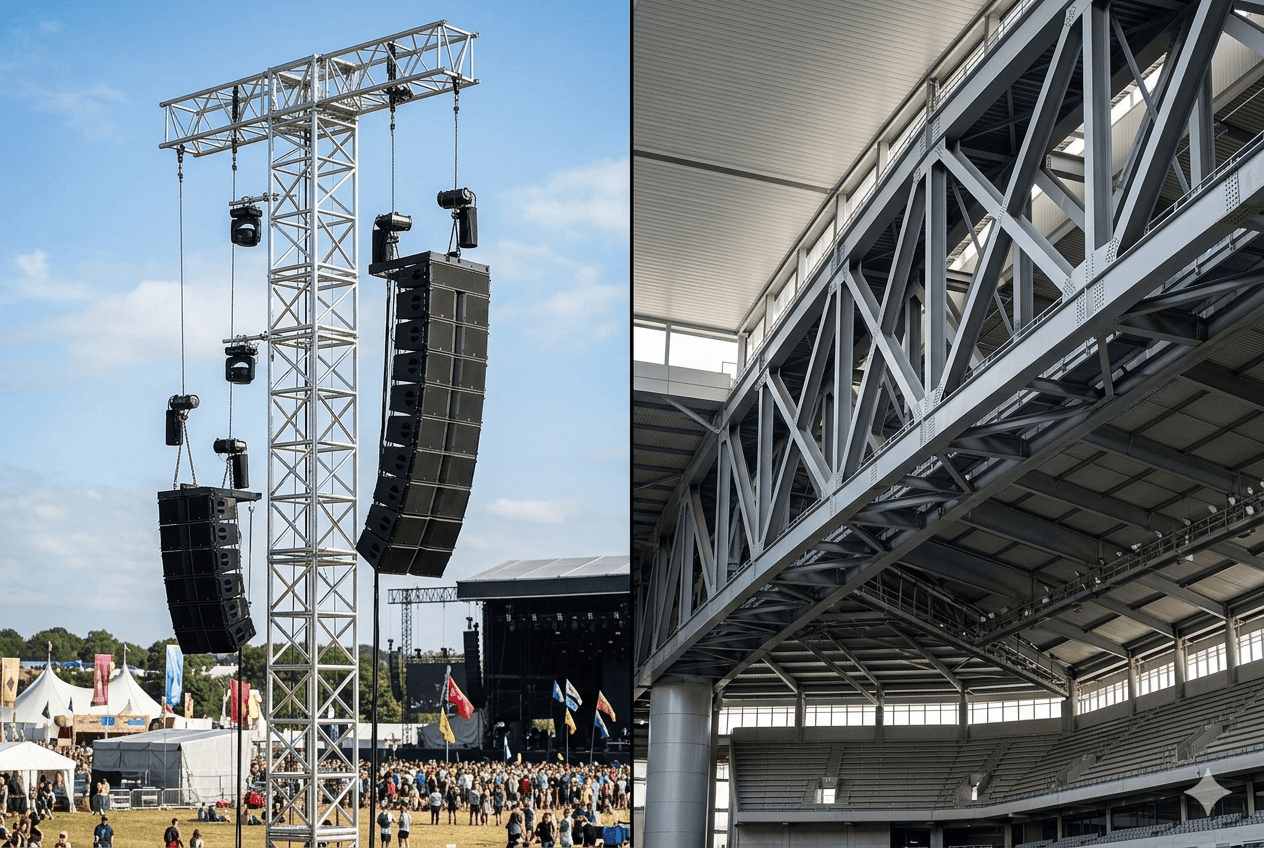
This quick answer is just the start. The best material for you isn't just about a spec sheet. It's about understanding the real-world risks and rewards for your specific business. As a manufacturer, I've seen clients make this choice for years. The smartest ones look beyond the initial price tag. They think about transport, labor, and long-term durability. Let's dig deeper into the questions you should be asking to make the right decision for your company's future.
Is Higher Load Capacity Always the Most Important Factor?
You see a steel truss with a higher load rating and think it's the safer bet. But this number ignores the hidden costs and challenges of its heavy weight.
No, a higher load capacity isn't always the top priority. You must balance capacity with your real-world needs like transport, labor, and setup speed. An aluminum truss with enough capacity for your job is often more practical and profitable than an over-specified, heavy steel truss.
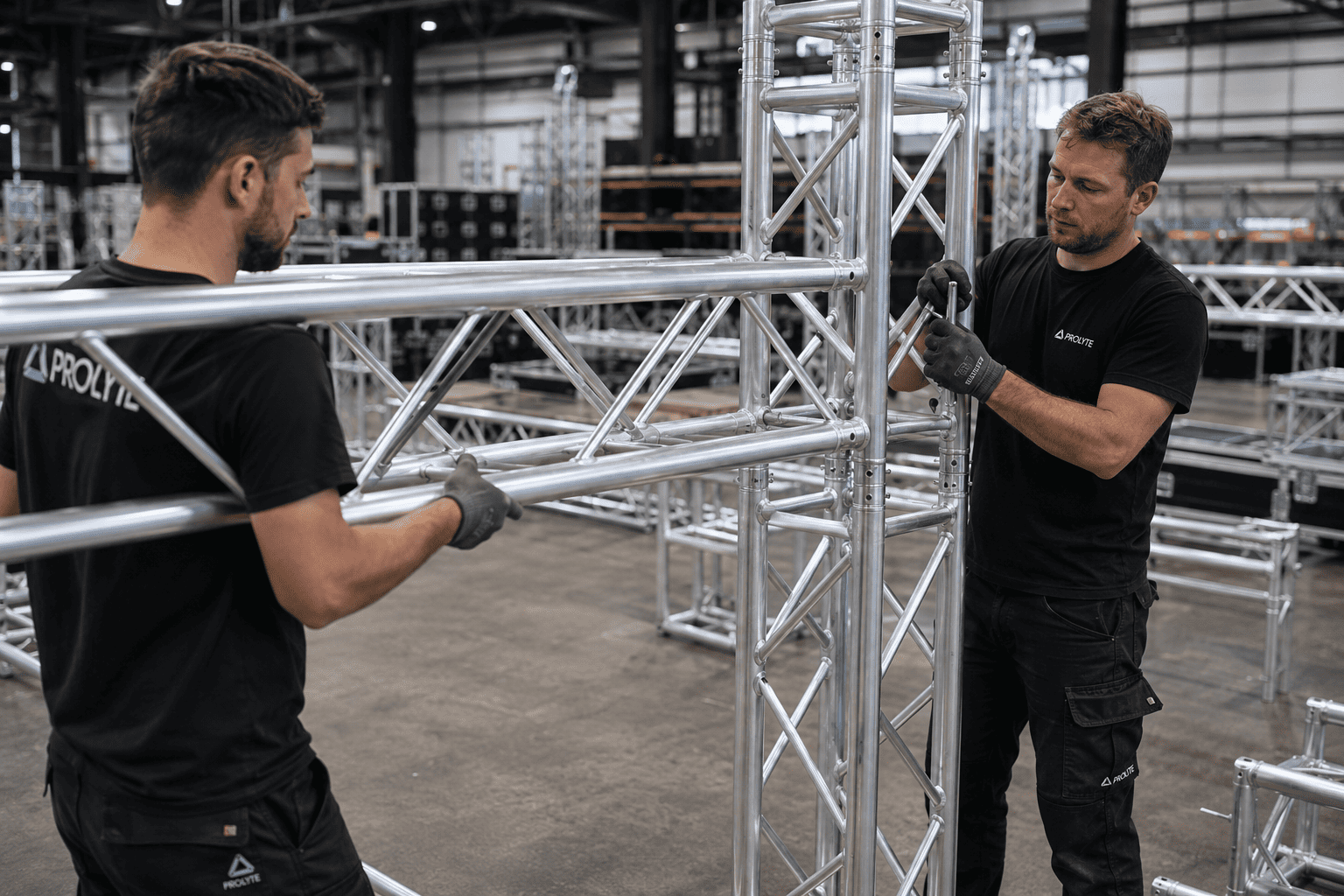
From my experience in production, customers often focus only on the maximum load number. On paper, steel almost always looks stronger. But strength on a spec sheet doesn't tell the whole story. The real question is: what strength do you actually need for your application, and what are you willing to sacrifice to get it? A heavy steel truss might hold more, but it also increases your transport costs, requires a larger crew, and might even need a crane for assembly.5 For a rental company doing weekend festivals, these operational costs add up fast. Lighter aluminum truss can be set up by a smaller team in less time, directly improving your profitability.
Balancing Strength and Practicality
Think about what you are actually lifting. Is it a massive permanent roof for a stadium or a set of lights and speakers for a corporate event? Your supplier should provide detailed load tables. But you should ask them questions that relate to your projects.
- "What is the safe working load for my specific 12-meter span?"
- "How much will this truss deflect or sag under my expected load?"
Comparing Real-World Trade-Offs
The "best" choice mitigates risk for your business model. Here is how we see it from the factory floor.
| Feature | Aluminum Truss | Steel Truss |
|---|---|---|
| Primary Focus | Portability, operational speed | Maximum load capacity |
| Hidden Risk 1 | Must verify capacity for long spans | High transportation and freight costs |
| Hidden Risk 2 | N/A | Increased labor costs and equipment rental |
| Best Use Case | Mobile events, tours, exhibitions | Permanent installs, heavy-duty roofs |
How Does the Environment Affect Your Truss Investment?
You bought a new truss system for outdoor events but didn't consider the weather. Now, rust is becoming a maintenance headache and a potential safety concern, hurting your investment.
The environment is critical. Aluminum naturally resists corrosion, making it ideal for outdoor or humid locations with almost no upkeep. Steel rusts easily and needs a protective coating like galvanization. This coating adds cost and requires constant inspection and repair to prevent structural failure.6
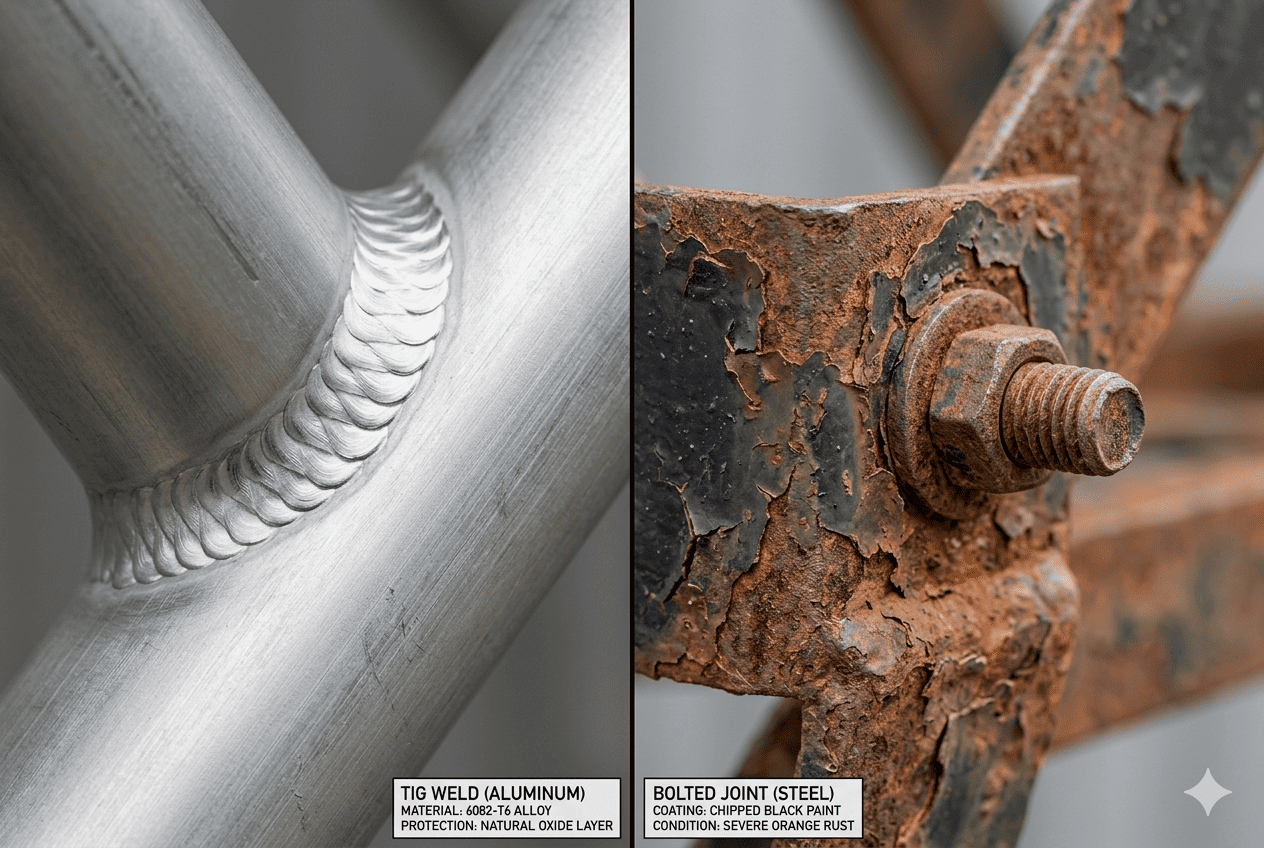
We often get feedback from clients years after delivery, and the environmental impact is a common theme. Aluminum truss ages incredibly well. The material naturally forms a protective layer of aluminum oxide when exposed to air. This layer prevents rust and corrosion. If it gets scratched, a new protective layer forms instantly.7 This is a huge advantage for rental companies. Your gear is constantly being loaded, unloaded, and assembled, and it's going to get bumped and scratched. With aluminum, you don't have to worry about those scratches turning into rust.
The Problem with Steel Coatings
Steel, on the other hand, needs protection. It must be coated with paint, powder coating, or galvanization. While these coatings are effective when new, they are not permanent. A single chip from being dropped or dragged can expose the raw steel underneath. Once that happens, rust begins, and it can spread under the coating.8 The responsibility for inspecting and repairing this damage falls on you, the owner. This creates a long-term maintenance burden and a safety risk if it's not managed carefully.
Maintenance Over the Long Term
Consider the lifetime maintenance tasks for each material.
| Factor | Aluminum Truss | Steel Truss |
|---|---|---|
| Material Property | Naturally corrosion-resistant | Prone to rusting |
| Required Protection | None needed (anodizing is for looks) | Essential (galvanization or paint) |
| Maintenance Routine | Clean as needed | Regularly inspect coatings for chips, repair damage |
| Long-Term Risk | Very low | Structural weakness from hidden rust |
What Is the True Cost of Your Truss Over Its Lifetime?
The initial price for that steel truss looks tempting and saves you money today. But you are not seeing the high shipping, labor, and maintenance costs that pile up over time.
The true cost of a truss system goes far beyond the purchase price. Aluminum often has a lower Total Cost of Ownership (TCO) because its light weight reduces shipping and labor expenses with every single use.9 Steel's weight can quickly erase its initial price advantage.
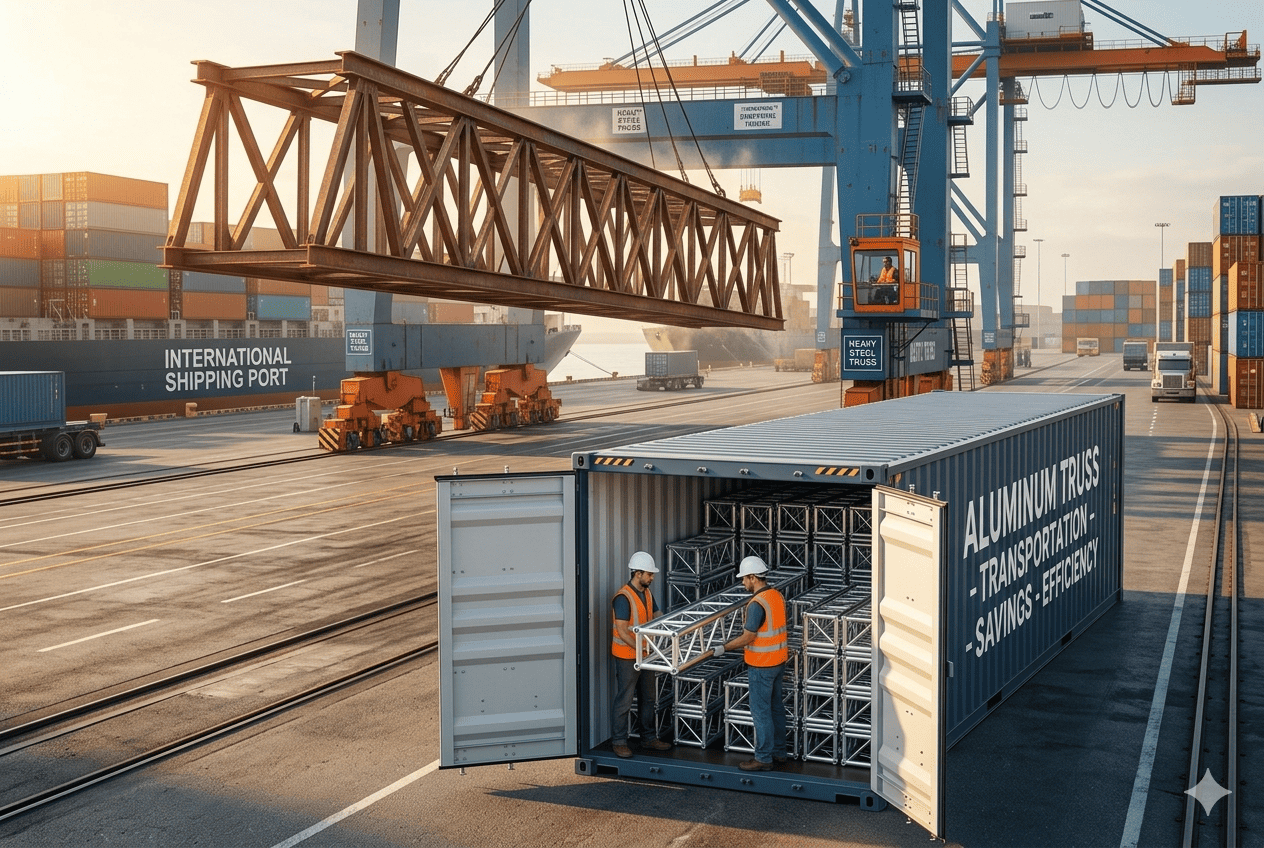
Calculating the Total Cost of Ownership (TCO) is the best way to make a smart financial decision. A client of ours in the US was once focused only on the lower per-foot price of steel. But then we helped him calculate the cost of shipping a full container from our factory to his warehouse. The shipping savings alone from choosing aluminum made a huge difference. Then, he factored in the cost of transporting the truss to each event. A lighter product means you can use a smaller truck or fit more gear on the same truck.10 This is a recurring saving that directly impacts your bottom line.
Breaking Down the Total Cost
Let's look at the four key cost areas over the life of the truss.
- Purchase Price: Steel can sometimes be cheaper per pound or kilogram, but you also need more of it by weight for the same length.11
- Transportation: This is a huge factor. Lighter aluminum means lower freight costs from the factory and lower fuel and vehicle costs for every single event.
- Labor: This is another recurring cost. A lighter truss means a smaller crew and faster setup and teardown.12 This allows you to do more jobs with the same team.
- Maintenance: As we discussed, aluminum requires minimal maintenance, while steel requires an ongoing budget for inspection and repair.
Lifetime Cost Comparison
Here is a simple way to think about the financial choice.
| Cost Factor | Aluminum Truss | Steel Truss |
|---|---|---|
| Purchase Price | Can be higher | Can be lower |
| Shipping & Transport | Lower (recurring savings) | Higher (recurring cost) |
| Labor (Setup/Teardown) | Lower (fewer crew, faster) | Higher (more crew, slower) |
| Maintenance Costs | Minimal | Ongoing inspection & repair |
| Overall Lifetime Value | Often much higher | Often much lower |
Conclusion
The best truss choice depends on your business. Aluminum offers great value with its portability and low lifetime cost for mobile events. Steel is best for permanent, high-load structures.
"Stage lighting instrument - Wikipedia", https://en.wikipedia.org/wiki/Stage_lighting_instrument. Standard references on entertainment rigging and stage lighting note that modular trusses used for stages and lighting are commonly constructed from aluminum alloys to reduce weight and ease handling for touring and temporary installations. Evidence role: expert_consensus; source type: encyclopedia. Supports: That aluminum truss is commonly used in the entertainment/staging industry because its low mass facilitates transport and assembly.. Scope note: Such sources establish prevalent use and rationale but do not determine what is 'superior' for every company. ↩
"Aluminium - Wikipedia", https://en.wikipedia.org/wiki/Aluminium. Encyclopedic data report aluminum’s density at roughly 2.7 g/cm3 versus about 7.8 g/cm3 for carbon steel, implying substantially lighter like-for-like components and easier manual handling and transport. Evidence role: mechanism; source type: encyclopedia. Supports: That aluminum has much lower density than steel, resulting in lower component mass for similar geometries and easing handling.. Scope note: While lower mass supports easier handling, actual labor cost reductions depend on specific workflows and contracts. ↩
"Aluminium oxide - Wikipedia", https://en.wikipedia.org/wiki/Aluminium_oxide. Reference works explain that aluminum rapidly forms a thin, adherent aluminum oxide film in air that passivates the surface and provides significant corrosion resistance in many environments. Evidence role: mechanism; source type: encyclopedia. Supports: That aluminum spontaneously forms a protective oxide layer that resists corrosion in many environments.. Scope note: Corrosion performance and maintenance needs vary with specific environments (e.g., chloride exposure), so ‘perfect’ and ‘minimal’ are context-dependent. ↩
"Steel bridge - Wikipedia", https://en.wikipedia.org/wiki/Steel_bridge. Structural engineering references describe structural steel as a primary material for buildings and bridges owing to its high strength and stiffness (with Young’s modulus around 200 GPa compared to about 69 GPa for aluminum). Evidence role: historical_context; source type: encyclopedia. Supports: That structural steel has higher stiffness than aluminum and is widely used for heavy permanent structures like buildings and bridges.. Scope note: This establishes typical practice and material properties, not a universal rule for every installation. ↩
"OSHA procedures for safe weight limits when manually lifting", http://www.osha.gov/laws-regs/standardinterpretations/2013-06-04-0. NIOSH guidance on the Revised Lifting Equation identifies a recommended weight limit of 51 pounds for ideal conditions and advises team lifting or mechanical assistance for heavier or less favorable tasks, implying that heavier components typically necessitate more personnel or lifting equipment. Evidence role: expert_consensus; source type: government. Supports: That heavier individual components often require team lifting or mechanical assistance for safe handling, affecting crew size and equipment needs.. Scope note: Guidance concerns manual material handling generally and does not specify thresholds for truss assembly or crane selection. ↩
"[PDF] Best Practices for Corrosion Control and Mitigation", https://highways.dot.gov/media/51611. Federal guidance on steel structures notes that carbon steel is susceptible to corrosion without protection and that protective coating systems must be periodically inspected and maintained to control corrosion over service life. Evidence role: general_support; source type: government. Supports: That carbon steel requires protective coatings to control corrosion and that such coatings require periodic inspection and maintenance.. Scope note: This evidence is drawn from civil infrastructure contexts (e.g., bridges) and illustrates general practice rather than truss-specific maintenance schedules. ↩
"Passivation (chemistry) - Wikipedia", https://en.wikipedia.org/wiki/Passivation_(chemistry). Materials references explain that freshly exposed aluminum surfaces quickly develop a thin, adherent oxide film in air, restoring the protective passive layer after mechanical damage. Evidence role: mechanism; source type: encyclopedia. Supports: That aluminum spontaneously and rapidly forms an oxide film on freshly exposed surfaces.. Scope note: ‘Instantly’ is an approximation; formation rate and protective efficacy depend on environment. ↩
"Specifics and Methods of Inhibiting the Underfilm Corrosion ... - PMC", https://pmc.ncbi.nlm.nih.gov/articles/PMC10974378/. Government corrosion guides describe that when a protective coating is damaged, corrosion often initiates at the defect and can propagate under adjacent intact coating, a process known as underfilm corrosion. Evidence role: mechanism; source type: government. Supports: That corrosion can initiate at coating defects and progress under the remaining coating (underfilm corrosion).. Scope note: Specific rates and extent of underfilm corrosion depend on coating system and environment. ↩
"[PDF] The 2025 EPA Automotive Trends Report", https://www.epa.gov/system/files/documents/2026-02/420r26001.pdf. Federal agencies report that reducing vehicle mass decreases fuel consumption for a given duty cycle, indicating that lighter loads generally incur lower transportation energy costs. Evidence role: mechanism; source type: government. Supports: That reducing vehicle/cargo mass lowers fuel consumption, implying lower transport costs for lighter equipment.. Scope note: This supports the transport-cost component of TCO; it does not quantify labor or total ownership costs for truss systems. ↩
"Compilation of Existing State Truck Size and Weight Limit Laws", https://ops.fhwa.dot.gov/freight/policy/rpt_congress/truck_sw_laws/app_a.htm. FMCSA materials describe federal interstate gross vehicle weight limits (commonly 80,000 lb for standard configurations), indicating that allowable payload is mass-limited and benefits from lighter equipment. Evidence role: historical_context; source type: government. Supports: That U.S. interstate trucking is subject to gross vehicle weight limits, constraining payload by mass.. Scope note: In some cases volume or axle spacing, rather than gross weight, may be the binding constraint. ↩
"Densities of the elements (data page) - Wikipedia", https://en.wikipedia.org/wiki/Densities_of_the_elements_(data_page). Materials references list aluminum’s density near 2.7 g/cm3 and carbon steel’s near 7.8 g/cm3, meaning members of equal volume (and length with the same cross-section) will have much greater mass if made from steel. Evidence role: mechanism; source type: encyclopedia. Supports: That steel’s density is roughly three times that of aluminum, so equal-volume members weigh substantially more.. Scope note: Final cost per unit length depends on cross-sectional design and performance requirements, not density alone. ↩
"Revised NIOSH Lifting Equation | Ergonomics - CDC", https://www.cdc.gov/niosh/ergonomics/about/RNLE.html. NIOSH’s Recommended Weight Limit framework indicates that as object mass increases beyond single-person limits, team lifting or mechanical assistance is needed, implying that lighter components reduce staffing and handling time demands. Evidence role: general_support; source type: government. Supports: That lighter loads can be lifted safely by fewer workers, while heavier loads often require team lifting or mechanical aids.. Scope note: Actual crew size and speed depend on task design, training, and site constraints; no direct timing study is provided. ↩