Skip to content
Choosing the right truss system feels complicated. The wrong choice can waste money and create setup headaches. Your decision should start with your event's specific needs, not just product photos.
The best choice depends on your use case. Goal Post systems are ideal for simple, front-facing displays like backdrops or entrances. 4-Post systems provide a full structure, offering more stability for heavier loads like lighting rigs, or when you need a defined space like a booth.1
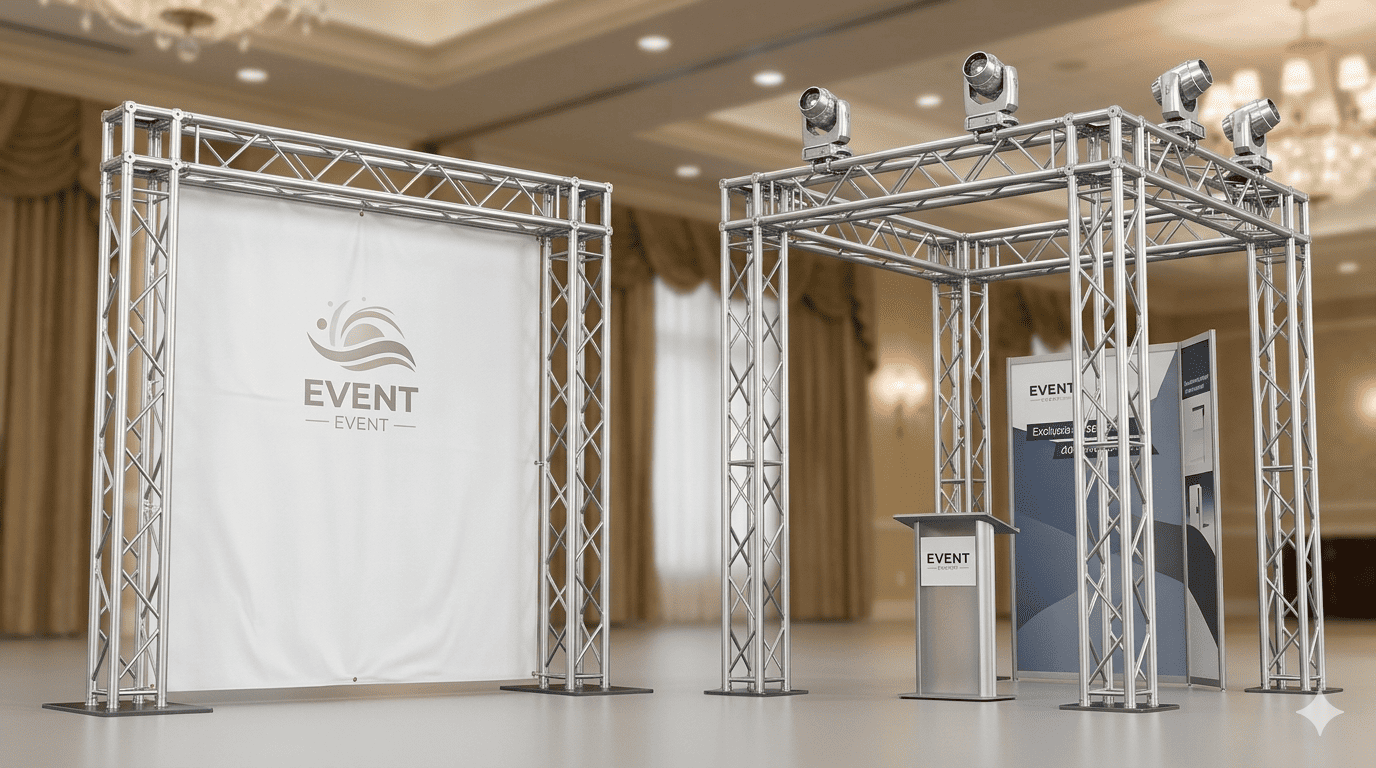
When I see clients deciding between these two systems, they often show me a photo of what they want. But a picture doesn't tell the whole story. The real decision comes down to practical details that ensure your event is safe, looks professional, and stays on budget. It’s not about which system is "better," but which is right for the job. Let's break down the questions you need to ask to find the perfect fit for your next event.
What Are You Actually Hanging on the Truss?
You see a great-looking truss online and want it for your event. But hanging a lightweight banner is completely different from supporting heavy stage lights. This is a common oversight.
For lightweight items like fabric backdrops, floral arrangements, or small logo signs, a Goal Post system is usually sufficient. For heavier equipment like LED screens, multiple professional lights, or complex decorations, a 4-Post system provides the necessary support and stability. Always start by identifying the load.
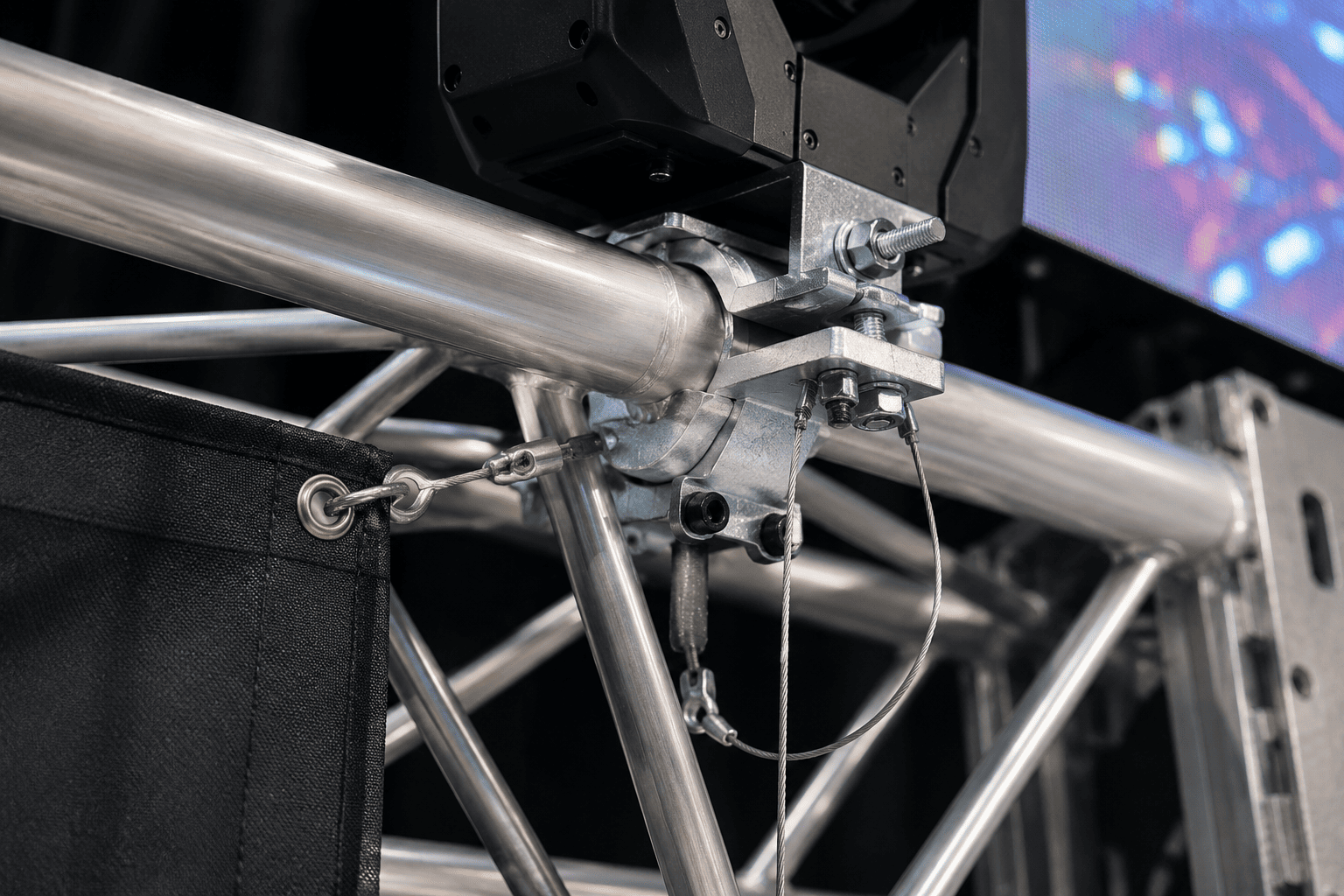
In my work at KRD Truss, the very first question I ask a client is, "What will you hang on it?" This question changes everything. The answer determines the level of risk and the type of structure we recommend. Customers building setups for weddings, exhibitions, or product launches often ask for a "truss frame" without thinking about the weight. A simple fabric backdrop for a wedding photo booth is a low-risk item. An expensive LED screen for a corporate launch is a high-risk item. You can't use the same system for both.
Defining Your Load
The load isn't just about weight; it's also about distribution.2 Are you hanging one central item or multiple items across the entire span?
Here is a simple way to think about it:
| Hanging Item | Typical System Recommendation | Key Consideration |
|---|---|---|
| Fabric Backdrops, Banners | Goal Post | Ensure the span is not too wide to cause sagging.3 |
| Floral Garlands, Drapes | Goal Post | Weight is low, but can be spread unevenly. |
| Small Logo Signs (Foam/PVC) | Goal Post | Very low weight, simple to mount. |
| Multiple Stage Lights | 4-Post | Needs multiple stable mounting points and power cables. |
| LED Video Wall | 4-Post | Very heavy, high risk, needs a robust structure. |
| Full Exhibition Booth | 4-Post | Creates a defined space and supports walls/shelves. |
A Goal Post system is essentially two vertical pillars and one horizontal crossbeam. It’s perfect for framing something. A 4-Post system creates a box, giving you four pillars and a top grid. This structure is inherently more stable and can handle weight from all directions.4 It also provides a stronger visual impression of a "zone" or "booth," which is why it's popular for trade show exhibits.
Do Span, Height, and Venue Limits Really Matter?
You found the perfect truss system in a picture. But will it actually fit your venue? Overlooking a single measurement can stop your setup cold, wasting time and money on-site.
Yes, these measurements are critical. The required width (span) and height directly influence the truss size and type you need. A wider span might require a sturdier 4-Post system for stability. Always check venue limits like ceiling height and available floor space before you buy anything.
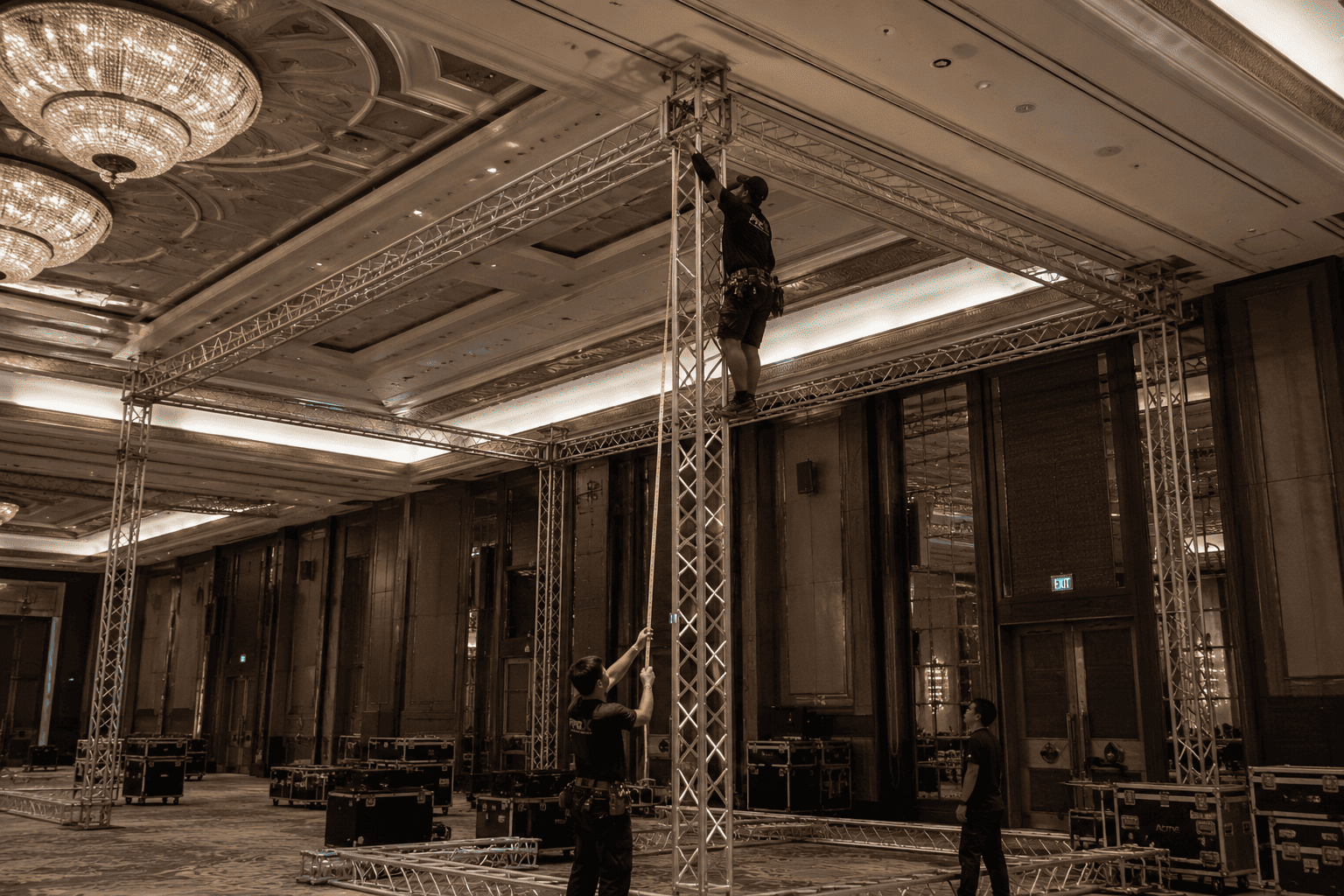
As a supplier, I often receive requests based on photos, but the critical details are missing. A customer might ask for a "10-foot goal post," but they haven't measured the ceiling height of their venue or the floor space available for the base plates. These details are more important than the product photo. A system that looks great in a large convention hall might be impossible to install in a hotel ballroom with a low ceiling. Thinking about these practical limits from the start saves you from major problems later.
Span and Stability
The span is the horizontal distance between the two support pillars. As the span increases, the potential for the horizontal truss to sag under its own weight (or with a load) increases.5 A 3-meter wide Goal Post for a wedding backdrop is very standard and stable. However, if you want a 10-meter wide banner entrance, a simple Goal Post system might not be enough. The long span would require a much heavier-duty truss or, more practically, a 4-Post system to provide intermediate support and prevent any sagging. A 4-Post system distributes the load across a wider grid, making it much better for long spans.
Height and Venue Ceilings
This seems obvious, but it's a frequent problem. You must know the exact ceiling height of your venue. Remember to account for anything hanging from the ceiling, like chandeliers or fire sprinklers. If your venue's ceiling is 3 meters high, you cannot order a 3-meter tall truss system.6 You need clearance to assemble and raise it. We usually recommend leaving at least 15-30 cm of space for safety and ease of installation.7 Also, consider the venue's floor. Is it level? Do you have enough space for the base plates, which can be quite large for taller structures? For outdoor events, you must also consider wind, which adds a significant force that Goal Post systems are less equipped to handle than enclosed 4-Post structures.8
Is the Purchase Price the True Final Cost?
You found a cheap truss system online that seems like a great deal. But hidden costs in shipping, labor, and setup can quickly turn that bargain into a budget nightmare.
No, the purchase price is only part of the story. You must consider the total cost of ownership.9 A 4-Post system costs more to buy, ship, and set up because it has more components and requires more labor.10 A Goal Post is cheaper to buy and much faster to install.
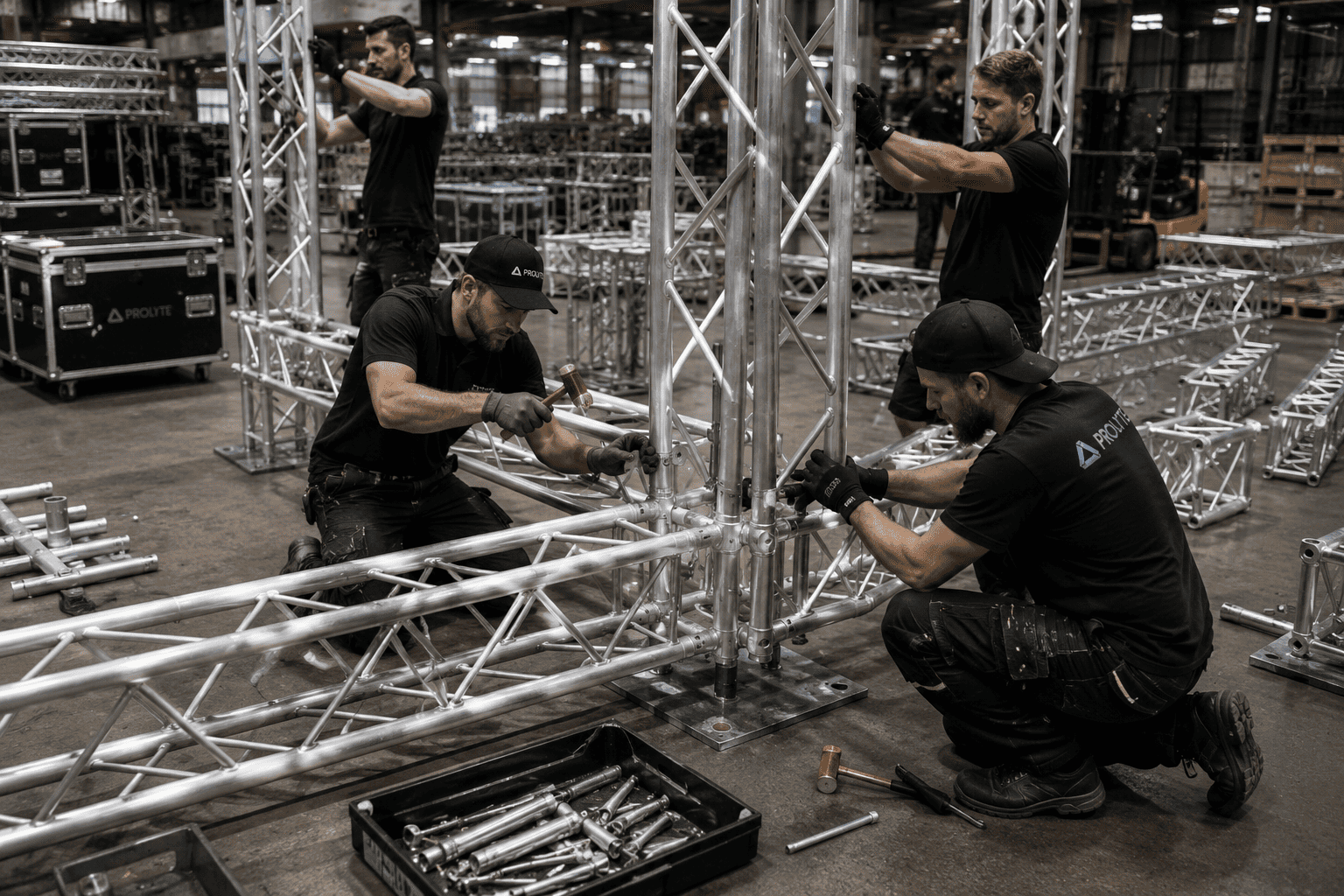
When I work with my clients, like Scott, a business owner who rents out event equipment, we talk about the entire project budget. The price tag on the truss is just the starting point. A 4-Post system might have a higher initial cost, but the real difference appears in logistics. It has more parts, which means higher shipping volume and weight. More parts also mean more time and labor are needed for assembly and disassembly. For a small event team, a Goal Post system that two people can set up in 20 minutes is far more efficient than a 4-Post system that needs four people and two hours.
Comparing the Full Cost
Let's break down where the money really goes. The decision isn't just about which is cheaper to buy today, but which is more cost-effective for your specific business model and event type. If you do many small, quick events, the efficiency of a Goal Post is a huge advantage. If you build large, elaborate trade show booths that stay up for a week, the stability and presence of a 4-Post system justify the extra cost.
| Cost Factor | Goal Post System | 4-Post System |
|---|---|---|
| Product Price | Lower | Higher |
| Shipping Volume | Lower. Fewer parts, fits in smaller vehicles. | Higher. More parts, requires a van or truck. |
| Installation Labor | Low. Often 1-2 people can assemble it quickly. | High. Needs a larger team and more time. |
| Setup Complexity | Simple. Two uprights, one crossbeam, two bases. | More complex. Involves building a cube or grid. |
| Visual Impact | Good for framing and backdrops. | Strong. Creates a defined, professional-looking space. |
| Versatility | Limited to front-facing displays. | High. Can be used for booths, lighting rigs, etc. |
For event rental companies, the speed of setup and teardown is money.11 Wasting an extra hour on a complex setup for a simple backdrop is lost profit. On the other hand, trying to save money by using a Goal Post for a job that really needs a 4-Post system can look unprofessional and even be unsafe, damaging your reputation.
Conclusion
Choosing between a Goal Post and 4-Post system is not about better or worse. It's about matching the truss to your event's true needs for hanging, space, and budget.
"Stability of trusses by graphic statics - Royal Society Publishing", https://royalsocietypublishing.org/rsos/article/8/6/201970/96094/Stability-of-trusses-by-graphic-staticsStability. A source on structural engineering principles can explain that a three-dimensional box truss provides significantly greater resistance to torsional (twisting) and lateral (sideways) forces compared to a two-dimensional portal frame (Goal Post), making it inherently more stable for complex or heavy loads. Evidence role: mechanism; source type: education. Supports: The claim that a 4-post (box) truss system offers greater stability for heavy loads.. ↩
"[PDF] 13. Structural Analysis and Evaluation - 13.1. Distribution of Live Load", https://dot.alaska.gov/stwddes/desbridge/assets/pdf/manual/ch13.pdf. An engineering or physics resource can define the difference between concentrated (point) loads and distributed loads, explaining how each type creates different stresses and deflection patterns on a structural element like a truss. Evidence role: definition; source type: encyclopedia. Supports: The claim that load distribution is a critical factor alongside total weight.. ↩
"[PDF] 3.5.3 Example 3.4: Deflection of a Pin-Jointed Truss", https://engineering.purdue.edu/~ce474/Docs/Truss_Examples.pdf. A source on structural mechanics can explain that deflection (sagging) in a beam or truss increases exponentially with its span, meaning even a small increase in length can cause a much larger sag under its own weight or an applied load. Evidence role: mechanism; source type: education. Supports: The claim that wider spans can lead to sagging (deflection).. ↩
"[PDF] Design Guidelines for Steel Trapezoidal Box Girder Systems", https://library.ctr.utexas.edu/ctr-publications/0-4307-1.pdf. A paper or textbook on structural analysis can demonstrate that a closed, three-dimensional section like a box truss has a high torsional constant and moment of inertia on multiple axes, allowing it to effectively resist twisting and bending forces from various directions. Evidence role: mechanism; source type: paper. Supports: The claim that a 4-post system's structure is inherently more stable and handles multi-directional loads better.. ↩
"[PDF] Analysis of Structures - Baylor University", https://web.ecs.baylor.edu/faculty/grady/_29_trusses.pdf. Sources on beam theory in physics or engineering confirm that deflection is directly proportional to the cube or fourth power of the span length, depending on the load and support conditions, illustrating why longer spans are significantly more susceptible to sagging. Evidence role: general_support; source type: education. Supports: The claim that sag (deflection) increases with the span of the truss.. ↩
"The New ESTA Rigging Standard - IAVM", https://iavm.org/the-new-esta-rigging-standard/. Installation manuals and safety guidelines for event rigging, such as those from the Event Safety Alliance or PLASA, specify that adequate clearance is required to safely assemble and tilt-up truss structures, preventing collisions with ceilings or overhead fixtures. Evidence role: general_support; source type: government. Supports: The claim that a truss system requires clearance below the ceiling for installation.. Scope note: Specific clearance amounts may vary, but the general principle is widely established in safety protocols. ↩
"[PDF] ANSI ES1.18-2022, Event Safety - Rigging - Squarespace", https://static1.squarespace.com/static/6154c1e0c2f7b519ccf2e2a9/t/649dc23552394e751859ea33/1688060472871/ANSI+ES1.18+-+2022+Event+Safety+-+Rigging.pdf. Industry best practice documents, for example from organizations like PLASA, often provide guidance on necessary clearances for the safe assembly of temporary structures, confirming the need for space to maneuver components and tilt the structure into place. Evidence role: expert_consensus; source type: institution. Supports: The recommendation to leave a specific amount of clearance (e.g., 15-30 cm) for truss installation.. Scope note: While sources confirm the need for clearance, the exact numerical value of 15-30 cm may be a rule of thumb rather than a formal standard. ↩
"[PDF] Appendix A Example 1: Wind Loads - Caltrans", https://dot.ca.gov/-/media/dot-media/programs/engineering/documents/structureconstruction/temp-str/temp-str-app-a1-a11y.pdf. Engineering standards for temporary structures, such as ANSI E1.21, detail the significant impact of wind loading. These sources explain that open, two-dimensional frames have less resistance to lateral wind forces compared to three-dimensional structures, which can be more effectively braced or ballasted against such loads. Evidence role: mechanism; source type: government. Supports: The claim that Goal Post systems are more vulnerable to wind than 4-Post systems.. ↩
"total cost of ownership (TCO) for equipment rental - Hapn", https://gethapn.com/blog/total-cost-of-ownership-tco-for-equipment-rental/. Business management or event industry resources explain that the Total Cost of Ownership (TCO) includes not only the initial purchase price but also all direct and indirect costs over the asset's lifecycle, such as shipping, labor for setup/teardown, maintenance, and storage. Evidence role: definition; source type: other. Supports: The claim that total cost of ownership is the correct metric for evaluating the cost of a truss system.. ↩
"Installation Labor Rates 2026 & Truss Cost Analysis - CountBricks", https://www.countbricks.com/post/cost-of-trusses-residential. Event production industry reports and case studies often analyze project budgets, showing that structures with more components, like 4-post systems, typically require more truck space, longer load-in/load-out times, and larger setup crews, thereby increasing variable costs beyond the initial purchase. Evidence role: case_reference; source type: other. Supports: The claim that 4-post systems incur higher logistical and labor costs compared to goal-post systems.. Scope note: The exact cost difference is highly variable and depends on the specific event, location, and labor rates. ↩
"Meeting, Convention, and Event Planners - Bureau of Labor Statistics", https://www.bls.gov/ooh/business-and-financial/meeting-convention-and-event-planners.htm. Trade publications for the event rental industry frequently emphasize that labor is a primary operational cost, and therefore, equipment that allows for faster setup and teardown enables crews to handle more events in a given period, directly increasing revenue potential and profitability. Evidence role: general_support; source type: other. Supports: The claim that setup/teardown speed is a critical profitability factor for event rental companies.. ↩