Skip to content
Struggling to find a reliable truss factory? You worry about quality, delays, and communication. What if you could confidently vet suppliers and avoid costly mistakes?
The best truss factory isn't a single company. It's the one whose strengths in customization, lead time, and quality control directly solve your business's biggest problems. The key is to match their capabilities to your specific project needs, transforming your search into a strategic partnership evaluation.
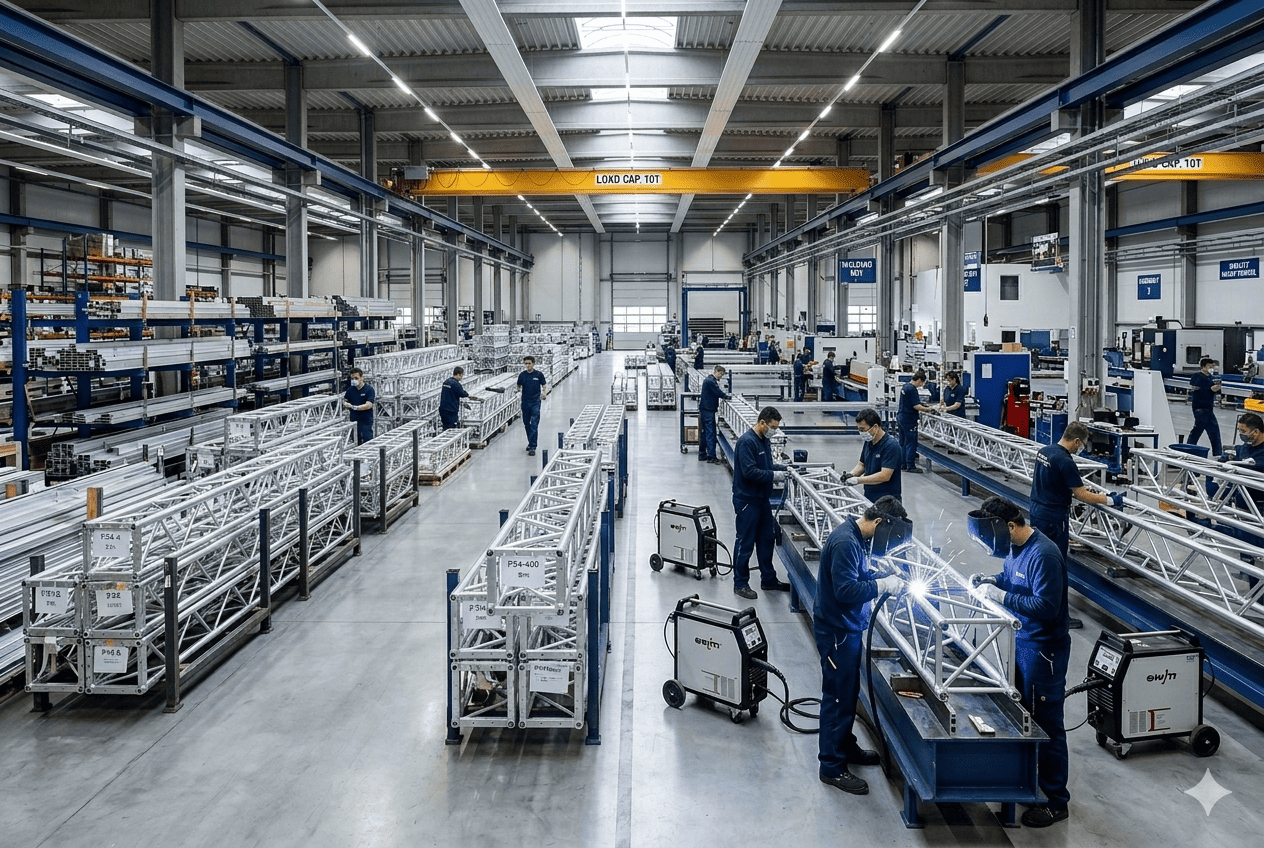
Finding that perfect match seems difficult. But it's not. It just requires asking the right questions. We have been manufacturing and exporting trusses for years, and I've seen what separates a great supplier from a risky one. Let's break down how to look beyond the sales pitch and find a true partner for your business. This is how you build a supply chain you can trust.
How do you define the "best" factory for your specific needs?
You see many factories claiming to be the "best." But their "best" might not be your "best." This mismatch can lead to project delays, wrong products, and frustration.
The "best" factory is the one that aligns with your business model. If you need urgent custom pieces, a factory that only makes high-volume standard orders is a poor fit. Define your top priority—price, customization, or speed—and find a supplier who excels there.

From my experience working with clients like Scott in the US, their needs are very specific. They run an event rental business. They don't need thousands of the same truss piece. They need a partner who can quickly create a few custom-sized sections for a unique stage design and do it without a huge minimum order quantity (MOQ). This is a common pain point. The "best" factory for Scott is one built for flexibility and customization. For a massive production company that only uses standard sizes, the "best" factory might be a high-volume producer with the lowest price. You have to diagnose your own needs first.
Matching Your Needs to Factory Strengths
To find your fit, you need to be honest about what you value most. Is it the absolute lowest price, or is it the security of getting a custom part delivered on time? Here is how we break it down when talking to new clients.
| Your Business Need | Ideal Factory Profile | Red Flags to Watch For |
|---|---|---|
| Custom Sizes & No MOQ | Agile factory with a strong in-house engineering team. Values partnership. | Factory only shows standard products, rigid pricing structure, high MOQ. |
| Fastest Possible Delivery | Stable production schedule, deep knowledge of international shipping routes. | Vague answers on lead times, history of delays, unfamiliar with your country's customs. |
| Highest Quality & Safety | Transparent about materials and processes, provides all certifications. | Hesitates to share documents, focuses only on price, cannot explain their welding process. |
| Lowest Price | High-volume mass producer of standard sizes. | Quality is often compromised, poor communication, inflexible on any changes. |
What documents truly prove truss quality beyond the product page?
Every supplier says they use "high-quality 6082-T6 aluminum1." But how can you be sure? Relying on words alone is a huge risk for your events, your clients, and your reputation.
Go beyond the "6082-T6" claim. Ask for a material certificate for the specific aluminum batch used for your order. Also, request their welding process certification, like a TUV certificate2, and evidence of load testing for the truss designs you are buying.

When a client asks me for proof of quality, I don't just send them a catalog. I show them the paperwork. This is the difference between a professional factory and a simple workshop or trading company. A trading company can't give you a material certificate for the batch of aluminum your truss will be made from.3 They don't have it. A true factory does. These documents are not just pieces of paper; they are your insurance policy. They are the proof that you are getting exactly what you paid for and that it's safe.
The Three Documents That Matter
When you review a potential supplier, ask for these three specific items. If they can't or won't provide them, that is a major red flag.
-
Material Certificate: This document links your truss directly to the specific batch of raw material from the aluminum mill. It proves the chemical composition and mechanical properties of the aluminum4. Without it, you are just trusting their word that they used 6082-T6 and not a cheaper, weaker alloy5. We keep these on file for every single order.
-
Welding Process Certification (e.g., TUV): This is critical. It doesn't just certify a single welder. It certifies the entire welding process6. It means the factory has a documented, repeatable, and audited system for welding that ensures every joint is consistently strong. It covers the type of welding wire used, the machine settings, and the welder's qualifications.
-
Load Test Reports: A spec sheet tells you the theoretical strength. A load test report proves it.7 A reputable factory physically tests its truss designs to see how much weight they can hold before they deform or fail. Ask for the report for the specific truss profile you plan to buy. It's your ultimate proof of safety and engineering.
How can you test a factory's logistics and communication skills before you buy?
A great product is useless if it's stuck in customs or arrives two weeks late. Poor communication adds stress and uncertainty, turning a simple order into a constant source of worry.
Test them with specific, real-world questions. Ask about their process for shipping to your country, including customs. See how they respond to a request for a custom design mock-up. Their speed, clarity, and expertise in the reply reveal their true capabilities.
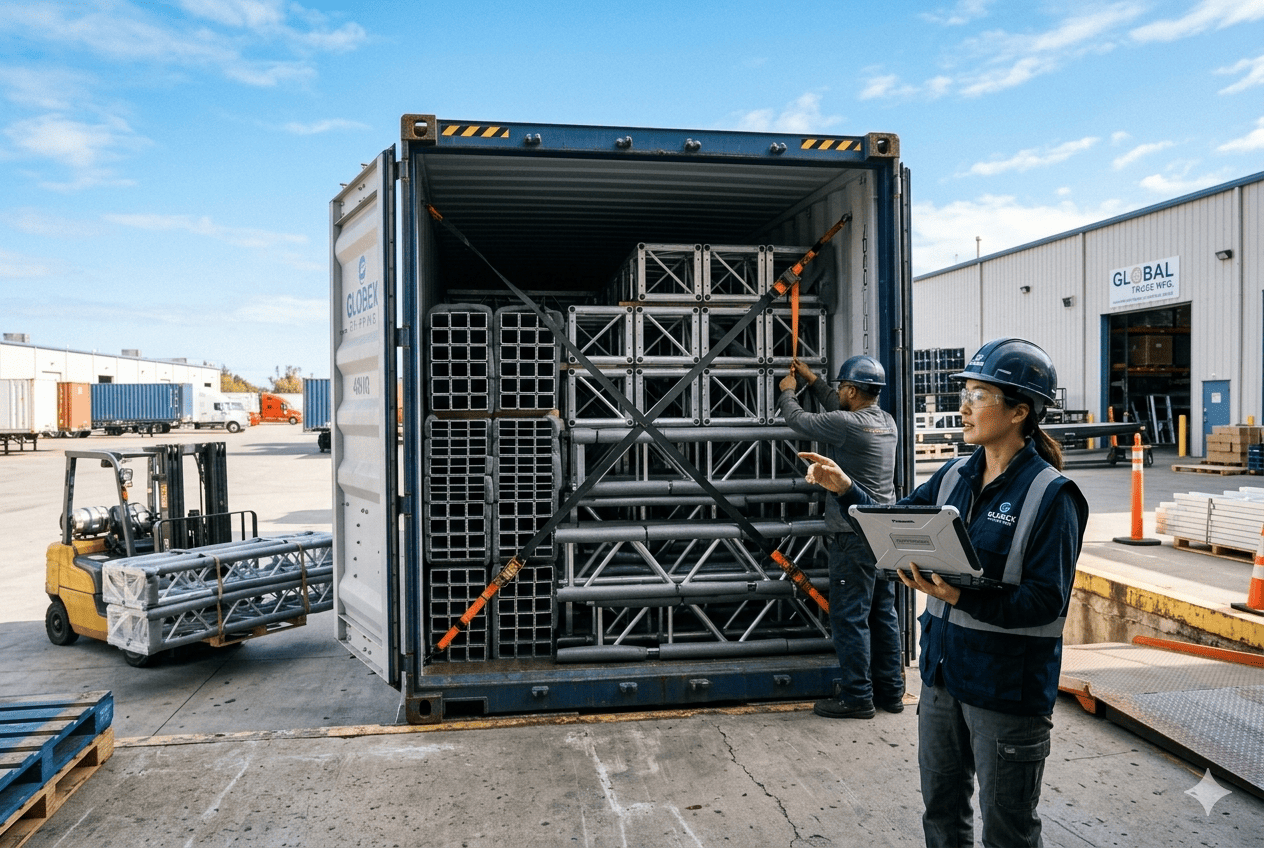
A factory's job doesn't end when the truss is built. For international clients, that's only half the battle. We handle shipments to the US, India, and Europe every week. I can tell you that a factory's knowledge of logistics is just as important as its manufacturing skill. A common question we get from new American buyers is about import duties and customs. A good partner should be able to answer this clearly. They should know what paperwork is needed and anticipate potential issues. If their answers are vague or they seem unsure, they probably don't have much experience exporting to your country. This is a risk you don't want to take.
A Checklist to Vet Supplier Responsiveness
Before you place an order, send the potential supplier a few test questions. Their answers will tell you everything.
-
The Logistics Test: Ask them, "What is your current production lead time plus sea freight time to the Port of Los Angeles? What documents do you prepare for US Customs clearance, and do you handle the ISF filing8?" A factory with experience will give you a clear, confident answer with specific timeframes and document names. A less experienced one will say, "We will check."
-
The Customization Test: Send a simple request like, "Can you please provide a basic 3D drawing and a quote for a 14.5-foot section of F34 box truss? I need it by tomorrow." Their speed, accuracy, and willingness to help on a small, hypothetical request show you how they will treat you when you're a real customer with an urgent need.
-
The Problem-Solving Test: Ask, "What is your standard procedure if a shipment is at risk of being delayed during the busy season before Christmas9?" This isn't a trick question. You are looking for honesty and a proactive plan. A good partner will talk about booking vessel space early, communicating transparently, and exploring alternative shipping options. A bad partner will just say, "It won't be delayed."
Why should you see your supplier as a supply chain partner, not just a vendor?
Focusing only on the lowest price per meter seems smart. But hidden costs from delays, errors, and poor support can quickly erase those savings and damage your projects.
A true partner acts as an extension of your own team.10 Their reliability, communication, and flexibility become your competitive advantage. The real value is not the unit price but the total cost of ownership11, including the cost of delays, errors, and your own management time.
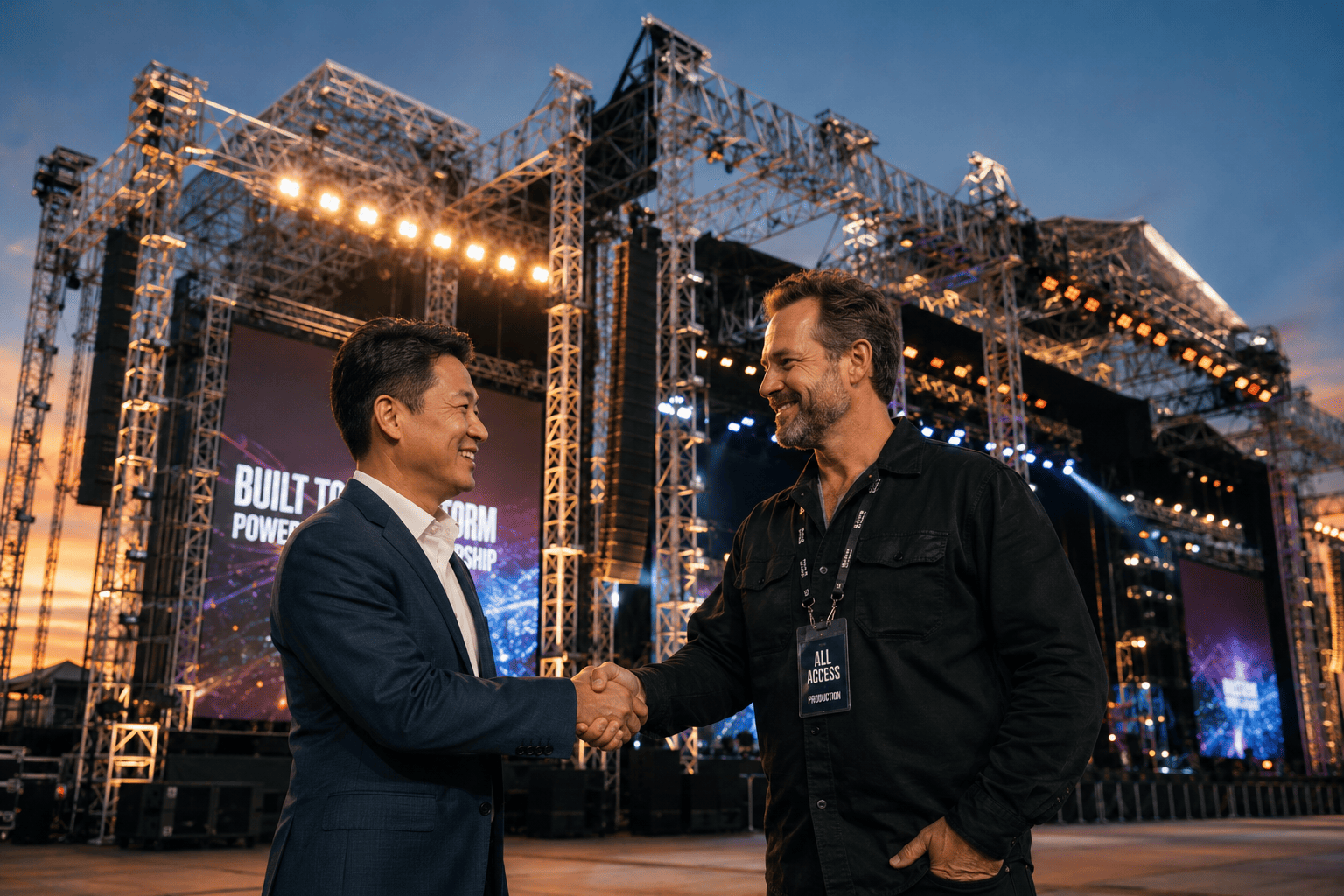
We have seen this happen many times. A client leaves to try a cheaper supplier. They save 10% on the invoice price. But then the shipment is a month late, forcing them to rent equipment locally at a high cost. Or, the truss arrives with a slight measurement error, and the supplier refuses to help. The initial 10% savings is gone, and so is their peace of mind. The most successful clients we have are the ones who don't see us as just a vendor. They see us as part of their operational team. They know they can call me with an urgent, complex request, and we will work with them to find a solution. That reliability is the real value.
The Real Cost: Vendor vs. Partner
Thinking in terms of partnership changes how you evaluate a supplier. It shifts your focus from a simple transaction to a long-term relationship that strengthens your business.
| Feature | Vendor Mindset (High Risk) | Partner Mindset (Low Risk) |
|---|---|---|
| Focus | Lowest price per unit. | Total cost of ownership and reliability. |
| Communication | Reactive and slow. Only responds to emails. | Proactive and fast. Anticipates your questions. |
| Customization | Seen as a problem or an extra charge. | Seen as an opportunity to help you succeed. |
| Problem Solving | "That's a shipping company issue. It's your problem." | "There is a potential delay. Let's solve this together." |
Ultimately, a low price means nothing if the supplier can't deliver on time, can't guarantee quality, and can't support you when things go wrong. A strong partner, on the other hand, helps you win more business because you can confidently promise your own clients custom solutions and reliable timelines.
Conclusion
Choosing the right factory is about risk management and partnership. By asking detailed questions about quality, logistics, and flexibility, you find a supplier who truly supports your business's success.
"6082 aluminium alloy - Wikipedia", https://en.wikipedia.org/wiki/6082_aluminium_alloy. Provides the technical specifications for the 6082-T6 aluminum alloy, noting its high tensile strength and corrosion resistance, which are critical properties for materials used in structural applications like event trusses. Evidence role: definition; source type: encyclopedia. Supports: That 6082-T6 is a specific aluminum alloy with properties like high strength and excellent corrosion resistance, making it a standard choice for high-stress structural applications.. ↩
"Welding Certification - TÜV SÜD", https://www.tuvsud.com/en-us/industries/manufacturing/welding. Explains that TÜV (Technical Inspection Association) organizations are independent bodies that certify products, processes, and systems for safety, quality, and compliance with international standards, making their certification a widely recognized benchmark. Evidence role: definition; source type: institution. Supports: That TÜV (Technischer Überwachungsverein) organizations are respected German institutions that provide independent inspection and product certification services, making their mark a globally recognized symbol of safety and quality.. ↩
"Why Supply Chain Management is Essential for Global Business", https://www.ucumberlands.edu/blog/how-supply-chain-management-impacts-international-business. Explains the distinct roles within a supply chain, where a manufacturer directly controls production inputs and maintains deep material traceability, while a trading company or distributor acts as an intermediary, which can limit direct access to batch-specific production records like material test reports. Evidence role: mechanism; source type: education. Supports: That manufacturers have direct control over production and access to batch-level documentation, whereas trading companies, as intermediaries, typically have less visibility and access to such detailed records.. Scope note: The source would explain the typical operational differences and limitations, not necessarily make an absolute claim that a trading company can never provide such a document, but it supports the high likelihood of this being the case. ↩
"Mill test report - Wikipedia", https://en.wikipedia.org/wiki/Mill_test_report. Defines a Mill Test Report (MTR), also known as a Certified Material Test Report (CMTR), as a quality assurance document provided by a metal manufacturer that certifies the material's compliance with specific standards and provides quantitative data on its chemical analysis and mechanical properties. Evidence role: definition; source type: institution. Supports: That a material certificate, often called a Mill Test Report (MTR), is a formal quality assurance document from the material's producer that certifies its chemical and mechanical properties against a specific standard.. ↩
"6061 Aluminum vs. 6082 Aluminum", https://www.makeitfrom.com/compare/6061-AlMg1SiCu-3.3214-H20-A96061-Aluminum/6082-AlSi1MgMn-3.2315-H30-A96082-Aluminum. Provides a comparison of common aluminum alloys, detailing their respective mechanical properties and typical applications. This data illustrates the performance differences between various grades, supporting the premise that weaker and potentially less expensive alternatives to 6082-T6 exist. Evidence role: general_support; source type: education. Supports: That different series of aluminum alloys (e.g., 6061, 6063) possess different mechanical properties, such as tensile and yield strength, which directly relates to their structural performance.. Scope note: The source would provide the technical data showing differences in alloy strength but may not directly state that substitution with cheaper alloys is a common fraudulent practice. ↩
"WPS vs. PQR | What's the Difference", https://sawyerfab.com/wps-vs-pqr/. Explains that a Welding Procedure Qualification Record (WPQR or WPQ) is the formal documentation proving that a company's welding procedure can produce welds with the required properties, which is distinct from the certification of an individual welder's skill. Evidence role: definition; source type: institution. Supports: That a Welding Procedure Qualification Record (WPQR) validates a company's documented process for creating a weld, while a welder's qualification certifies an individual's ability to perform that weld.. ↩
"Published Documents - ESTA TSP", https://tsp.esta.org/tsp/documents/published_docs.php. Industry standards, such as those from the Entertainment Services and Technology Association (ESTA), specify protocols for the design and testing of entertainment rigging equipment, often including requirements for physical load testing to validate calculated load ratings and ensure safety. Evidence role: general_support; source type: institution. Supports: That industry standards for entertainment technology and live events recommend or mandate physical load testing to verify the load ratings of rigging components like trusses.. ↩
"Import Security Filing (ISF) - When to submit to CBP", https://www.help.cbp.gov/s/article/Article-1868. According to U.S. Customs and Border Protection (CBP), the Importer Security Filing (ISF), or '10+2,' is a mandatory report that provides advance electronic cargo information for security screening before goods are brought into the United States by vessel. Evidence role: definition; source type: government. Supports: That the Importer Security Filing (ISF) is a mandatory regulation by U.S. Customs and Border Protection (CBP) requiring advance electronic submission of shipment data for cargo arriving in the US by sea.. ↩
"Latest Supply Chain and Freight Indicators", https://www.bts.gov/freight-indicators. Analysis from the logistics and shipping industry confirms a recurring 'peak season' in global freight, typically in the third and fourth quarters, where increased consumer demand strains capacity, leading to significant delays and higher costs. Evidence role: statistic; source type: research. Supports: That the period leading up to the end-of-year holidays, known as 'peak season' in logistics, is characterized by a surge in shipping volume that often causes port congestion, carrier delays, and increased freight costs.. ↩
"Mastering the Art of Supply Chain Collaboration and ...", https://www.ucumberlands.edu/blog/mastering-the-art-of-supply-chain-collaboration-and-teamwork. Research in supply chain management highlights the benefits of strategic supplier partnerships, where close collaboration, shared goals, and mutual trust can lead to greater operational efficiency, risk reduction, and competitive advantage compared to traditional, price-focused vendor relationships. Evidence role: expert_consensus; source type: paper. Supports: That shifting from a transactional vendor relationship to a collaborative partnership with key suppliers can lead to benefits like increased innovation, improved reliability, and a lower total cost of ownership.. ↩
"12 Key Elements Of Total Cost Of Ownership - Supply Technologies", https://www.supplytechnologies.com/resources/blog/12-key-elements-of-total-cost-of-ownership. Defines Total Cost of Ownership (TCO) as a supply chain and procurement analysis that calculates the full cost of an asset over its lifecycle, including not only the initial purchase price but also all direct and indirect costs such as shipping, maintenance, and potential downtime. Evidence role: definition; source type: education. Supports: That Total Cost of Ownership (TCO) is a financial principle used to assess the full lifetime cost of an asset, including direct and indirect costs like purchase price, maintenance, operational expenses, and disposal.. ↩