Skip to content
Choosing the wrong truss can be a costly and dangerous mistake. It can lead to setup delays, safety issues, or simply look unprofessional. Understanding the basics helps you choose wisely.
Trusses are categorized by connection type (spigot, bolted), shape (ladder, triangular, square), and material (aluminum, steel).1 Each type is designed for specific loads and uses, from small trade show displays to massive concert stages. Knowing the difference ensures your event is both safe and successful.

It's easy to get lost in the jargon of truss types and sizes. You hear terms like "spigot," "box," and "F34," but what do they actually mean for your project? Don't worry. I've been manufacturing trusses for years, and I'm here to make it simple. Let's break down each type so you can choose with confidence for your next event rental, installation, or tour.
Spigot vs. Bolted Truss: Which Connection Is Best For You?
Fumbling with nuts and bolts during a time-sensitive setup is a huge pain. You lose valuable time, and a single lost bolt can bring everything to a halt.
Spigot truss uses pins and clips for fast, tool-free assembly2, perfect for rentals and touring. Bolted truss uses nut-and-bolt connections for maximum rigidity, making it better for permanent installations or very heavy load applications where assembly speed is not the priority.
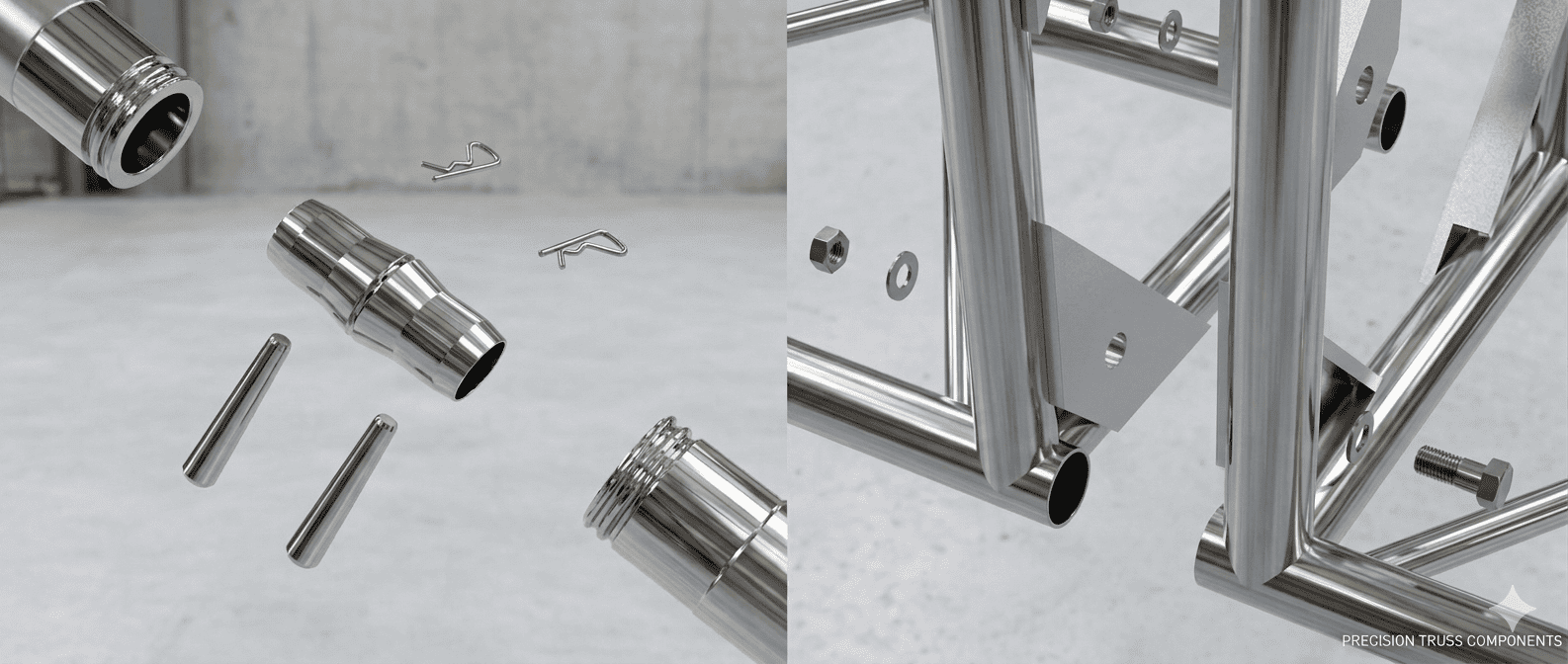
The connection system is one of the most important features of a truss. It determines how quickly you can set up and tear down your structures. Your choice here has a big impact on your labor costs and efficiency on site. I have seen clients save hours on a build simply by choosing the right connection type for their job. Let's look at the two main options.
Spigot Truss (Pin Truss)
This is the most popular type for the event and entertainment industry. It uses a conical connector system. You simply insert the conical end into the next piece of truss and secure it with a pin and R-clip. It is incredibly fast and requires no tools. For my clients in the rental business, this is a game-changer. Their crews can set up and tear down lighting grids or stage roofs much faster, allowing them to handle more jobs.
Bolted Truss (Screw Truss)
Bolted truss, sometimes called plate truss, uses flat aluminum plates at each end. You connect them by bolting them together. This system creates an extremely rigid and strong connection.3 However, it takes much more time to assemble and requires tools. We typically see this used for permanent installations in theaters, clubs, or architectural projects where the truss will not be moved often.
When to Choose Which?
| Feature | Spigot Truss | Bolted Truss |
|---|---|---|
| Assembly Speed | Very Fast | Slow |
| Tools Required | None (or a small hammer) | Wrenches and Sockets |
| Ideal Use | Rentals, Touring, Events | Permanent Installations |
| Rigidity | Excellent | Maximum |
For about 95% of my B2B clients, like event production companies, spigot truss is the clear winner because of its speed and ease of use.
Ladder, Triangle, or Square Truss: Does The Shape Really Matter?
You see different truss shapes but are not sure what the real difference is. Choosing based on looks alone could mean your structure can't support the weight you need.
Yes, the shape is critical. Ladder truss (2 chords) is for light-duty decorative use. Triangular truss (3 chords) offers more strength. Square truss (4 chords), also called box truss, provides the highest load capacity and is the standard for professional stages and grids.4
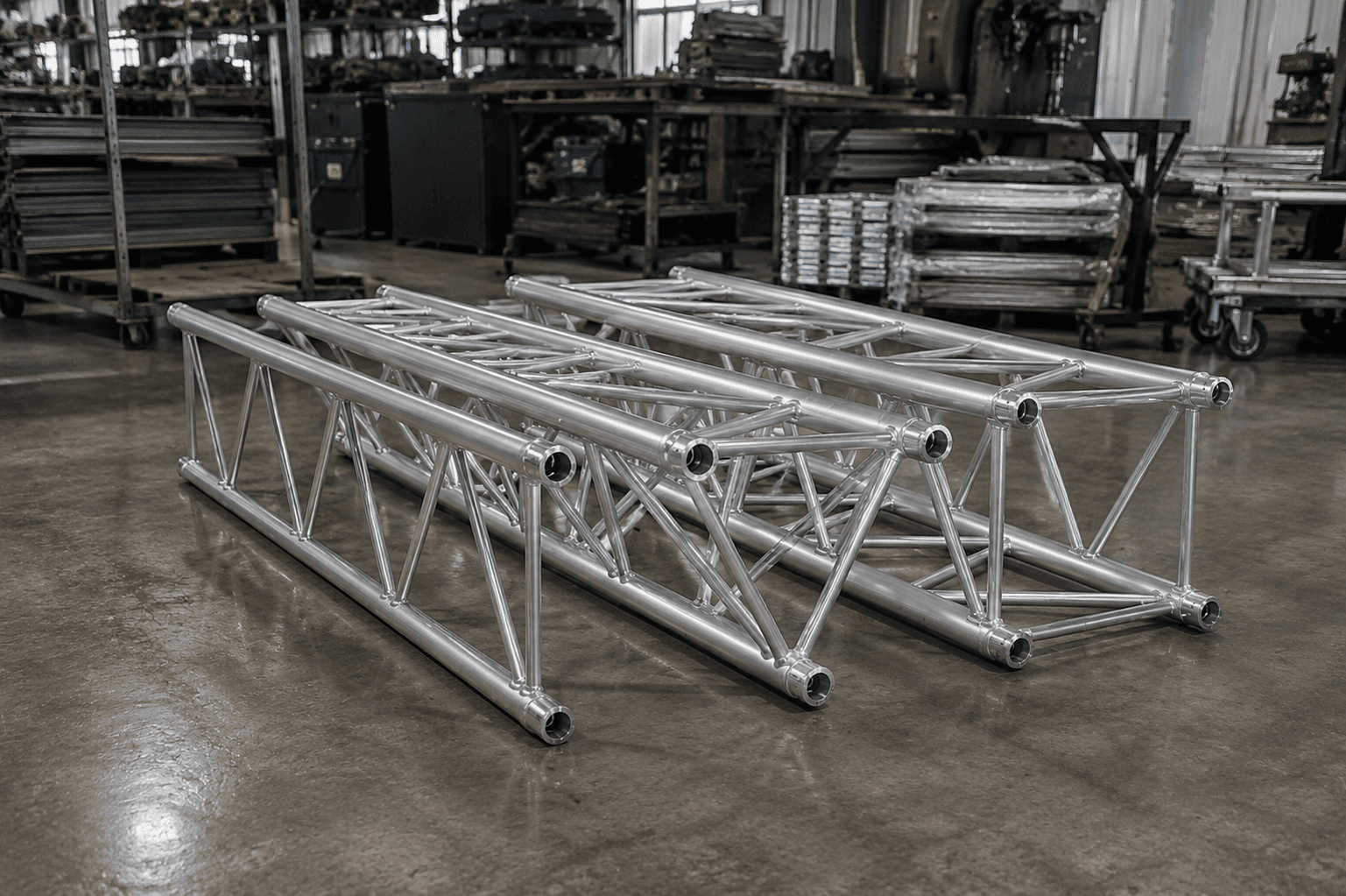
The shape, or profile, of the truss directly affects its strength and how you can use it. The number of long tubes, called chords, determines the profile. More chords and more bracing generally mean more strength, especially against twisting forces, which is called torsional strength.5 Let me explain the key differences so you don't over-spec or under-spec your next project.
Ladder Truss
As the name suggests, this truss looks like a ladder with two main chords. It is very lightweight and has the lowest cost. However, it is not very strong and can't handle much twisting.6 It's best used for decorative purposes, hanging light banners, or in retail displays where it's attached directly to a wall. Don't use it to span any significant distance.
Triangular Truss
This truss has three main chords. It's a good step up in strength from ladder truss. It can handle more weight and offers better resistance to twisting. We see clients use this for smaller trade show booths, DJ facades, and archways. It can be a good aesthetic choice, but for most professional lighting or stage applications, it's been replaced by square truss.
Box/Square Truss
This is the industry standard. With four main chords, it offers excellent strength in all directions. It has great vertical load capacity for hanging lights and sound equipment. It also has fantastic torsional strength, so it won't twist over long spans. For nearly all of our clients, from Scott in the US running a rental business to production companies in Europe, square truss is the answer. It's the most versatile, safe, and reliable option for building roofs, large lighting grids, and support structures.
| Profile | Load Capacity | Torsional Strength | Common Use |
|---|---|---|---|
| Ladder | Low | Very Low | Decoration, Signs |
| Triangular | Medium | Medium | Small Booths, Arches |
| Square (Box) | High | Very High | Stages, Lighting Grids, Roofs |
Aluminum vs. Steel Truss: Which Material Should You Invest In?
Heavy steel trusses are a nightmare to transport and set up. This adds to your labor costs, transport fees, and the physical strain on your crew, which nobody wants.
Aluminum truss is the modern industry standard for events and touring.7 It has a high strength-to-weight ratio, making it easy to handle. Steel truss is heavier and stronger, but it is typically reserved for permanent, large-scale industrial installations where weight is not a concern.
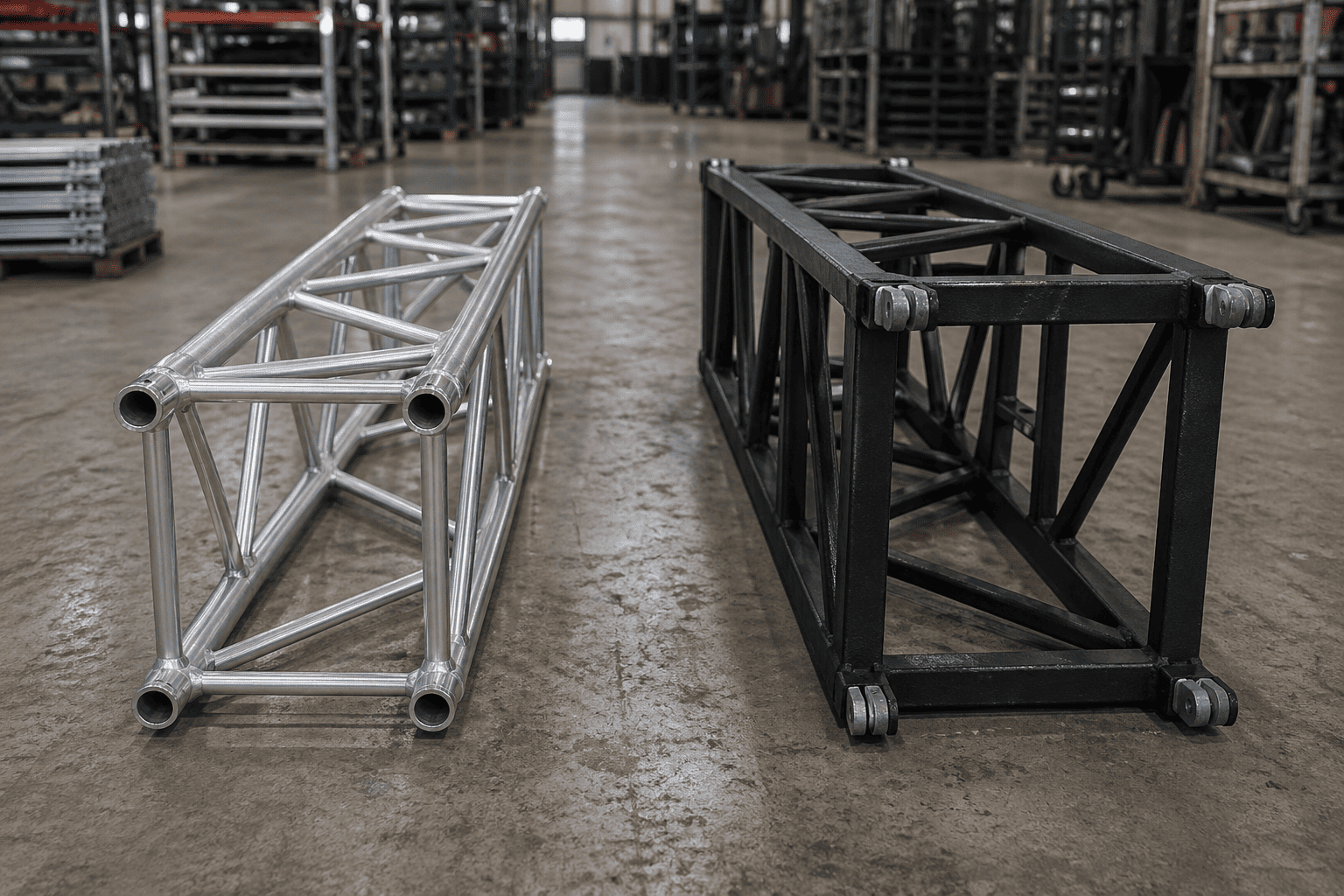
The material your truss is made from is a huge factor. It affects weight, strength, cost, and how long the truss will last. In the past, steel was common, but advances in metallurgy have changed everything. As a factory, we made a very deliberate choice about what material to specialize in, and I want to share why.
The Advantages of Aluminum Truss
We exclusively manufacture our trusses from high-grade 6082-T6 aluminum alloy. This material is the perfect fit for the event industry for several key reasons. First, it is incredibly strong but also very lightweight.8 This means a smaller crew can set it up, and you can save a lot of money on transportation. Second, aluminum naturally creates a protective oxide layer, so it will not rust like steel.9 This is critical for our clients who do outdoor events. An aluminum truss structure is an investment that will look professional and last for many years.
When Is Steel Truss Used?
Steel truss still has its place, but it's very niche. Because it is extremely heavy and strong, it's used for massive permanent structures like stadium roofs or large industrial buildings. For the world of events, touring, and exhibitions, it has too many disadvantages. The weight makes it expensive to ship and difficult to work with. It also must be painted or galvanized to prevent rust10, which adds cost and maintenance.
Why We Focus on Aluminum
At KRD Truss, we chose to specialize in aluminum truss because it directly solves the biggest problems for our B2B customers in the event business. It lowers their labor and logistics costs while providing all the strength and safety they need to hang expensive lighting and LED screens. It's a smarter investment for any company that needs to set up and tear down structures regularly.
Small, Medium, or Heavy-Duty Truss: How To Match The Size To The Job?
You're worried about buying a truss that is overkill for small jobs or unsafe for big ones. Wasting money on oversized truss or risking a failure is a real concern for any business owner.
Truss size, like 290mm or 400mm, corresponds to its duty rating. Small/light-duty (under 220mm) is for decoration. Medium-duty (like 290mm) is the versatile workhorse for most events. Heavy-duty (400mm+) is for large spans and heavy loads like concert roofs.11
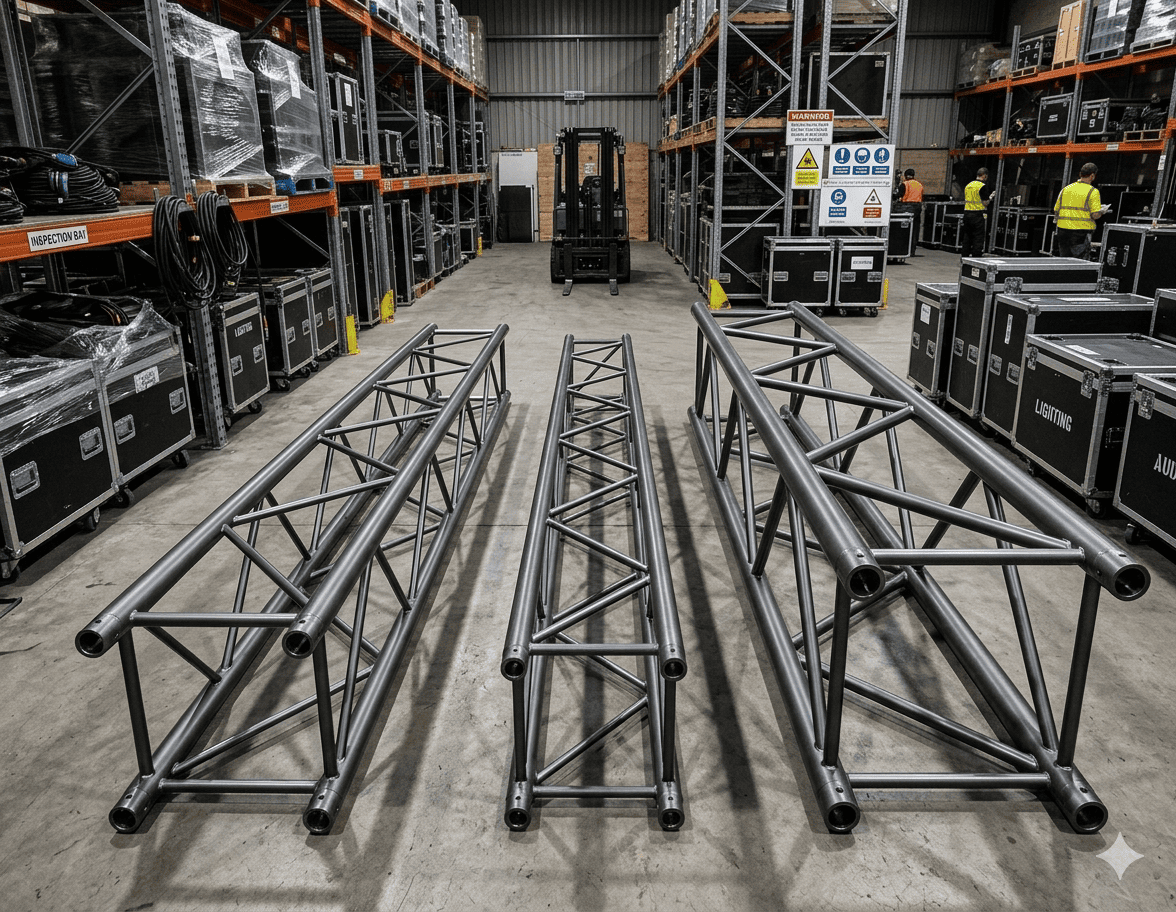
Finally, let's talk about size. When you see numbers like 290mm or 400mm (or 12" and 16" in the US), they refer to the overall width of the truss. This size, along with the diameter of the tube walls, determines its strength and how far it can span. Choosing the right size is crucial for safety and budget.
Light-Duty Truss
This category includes smaller truss profiles, often around 220mm (our F24 series). This type of truss is perfect for trade show booths, retail displays, and decorative elements. It's lightweight, easy to handle, and cost-effective for applications where you are not hanging anything heavy.
Medium-Duty Truss (The Workhorse)
This is the sweet spot for most applications, and the 290mm x 290mm (12"x12") box truss (our F34 series) is the king. As my insight noted, this is the most popular size for a reason. It offers a fantastic balance of strength, weight, and cost. It's strong enough for most indoor lighting grids, small outdoor stages, and finish lines. For rental companies, this is the size that pays the bills because it can be used for almost any job.
Heavy-Duty Truss
When you need to span long distances or hang very heavy loads (like large LED walls and moving light arrays), you need heavy-duty truss. These are larger profiles, such as 400mm (F44) or even larger pre-rig truss systems. These are used to build large stage roofs for concerts and festivals. We also produce speciality items like Forklift Truss, a massive and extremely strong truss designed to carry pre-loaded lighting bars, saving huge amounts of time on major tours.
Conclusion
Choosing the right truss means matching the connection, shape, material, and size to your specific job. By understanding these basics, you can build safely, work efficiently, and make a smart investment for your company.
"ANSI E1.2-2021: Aluminum Trusses and Towers", https://blog.ansi.org/ansi/ansi-e1-2-2021-aluminum-trusses-and-towers/. An industry standard such as ANSI E1.2 (ESTA) outlines the design and use of aluminum trusses and towers for entertainment applications and reflects common classification by connector type, truss cross-section, and material. Evidence role: definition; source type: institution. Supports: That in entertainment rigging practice, aluminum trusses and towers are discussed and specified in terms of connector systems (e.g., conical/spigot vs. bolted), cross-section (two-, three-, four-chord), and material.. Scope note: The standard describes practices and terminology but may not present the taxonomy in a single explicit list. ↩
"OTTFF 30 Sets Conical Coupler Pins with R-Clip, Stage Lights Truss ...", https://www.amazon.com/OTTFF-Conical-Coupler-Accessories-Lighting/dp/B073S3CVDN. A professional standard or guidance document (e.g., ANSI E1.2 by ESTA) describes conical/spigot coupler systems for aluminum truss that are pinned and clipped, enabling rapid assembly without hand tools. Evidence role: general_support; source type: institution. Supports: That conical/spigot coupling systems in entertainment truss employ steel spigots with pins and retaining clips and are designed for quick assembly without wrenches.. Scope note: Actual assembly speed is operational and may vary by manufacturer and crew practice. ↩
"Support and Connection Types - MIT", https://web.mit.edu/4.441/1_lectures/1_lecture13/1_lecture13.html. Structural engineering texts and lecture notes distinguish between pinned and moment-resisting bolted connections, noting that bolted plate connections can provide high rotational stiffness and joint capacity compared to pinned joints. Evidence role: mechanism; source type: education. Supports: That bolted moment-resisting connections can provide higher rotational stiffness than pin-type connections, contributing to greater joint rigidity and strength.. Scope note: The actual rigidity of a specific truss joint depends on connection geometry, tolerances, and manufacturer design. ↩
"ANSI E1.2-2021: Aluminum Trusses and Towers", https://blog.ansi.org/ansi/ansi-e1-2-2021-aluminum-trusses-and-towers/. Industry standards and guidance for entertainment rigging (e.g., ANSI E1.2 by ESTA) document the widespread use of four-chord box truss as a common solution for stages and grids because of its multidirectional stiffness and capacity. Evidence role: expert_consensus; source type: institution. Supports: That four-chord (box) aluminum truss is widely used for professional stages and rigging grids due to its versatile capacity and torsional performance.. Scope note: ‘Highest load capacity’ is comparative and depends on specific geometry, alloy, and construction; not all 4-chord trusses outperform all 3-chord units of different sizes. ↩
"[PDF] Unit 12 Torsion of (Thin) Closed Sections", https://ocw.mit.edu/courses/16-20-structural-mechanics-fall-2002/d01996bd6822461f4dcbdc3fbf2ea16f_unit12.pdf. Mechanics of materials lectures on torsion of thin-walled sections explain that closed sections have much higher torsional stiffness than open sections and that added bracing and load paths increase structural rigidity. Evidence role: mechanism; source type: education. Supports: That closed or more fully braced sections provide significantly higher torsional rigidity than open sections, and additional load paths increase overall stiffness and strength.. Scope note: Quantitative effects are geometry-dependent; the statement is a general principle rather than a universal rule. ↩
"[PDF] Torsional Analysis of - Engineering Information Technology", https://user.eng.umd.edu/~ccfu/ref/Design-Guide-9-torsion.pdf. Engineering references on torsion note that open sections (like ladder-like forms) have low torsional stiffness compared with closed box sections, explaining why two-chord ladder truss resists twisting poorly. Evidence role: mechanism; source type: education. Supports: That open, two-chord ladder-like sections exhibit low torsional rigidity relative to closed, multi-chord box sections.. Scope note: Specific performance varies with member sizes, web configuration, and span. ↩
"TSP - ESTA Technical Standards Program", https://tsp.esta.org/tsp/documents/published_docs.php. Standards from entertainment technology bodies (e.g., ANSI E1.2 by ESTA) address the design and use of aluminum trusses in shows and touring, evidencing aluminum’s role as the common material standard in these contexts. Evidence role: historical_context; source type: institution. Supports: That entertainment industry standards and guidance focus on aluminum trusses and towers for event and touring applications, indicating prevalent usage.. Scope note: Prevalence can vary by region and project type; steel systems are still used for certain applications. ↩
"6082 aluminium alloy - Wikipedia", https://en.wikipedia.org/wiki/6082_aluminium_alloy. Reference data (e.g., encyclopedia entries) report 6082‑T6 as a high-strength aluminium alloy used in structural applications, and note aluminium’s density (~2.70 g/cm³) is roughly one-third of carbon steel’s, supporting the high strength-to-weight characterization. Evidence role: mechanism; source type: encyclopedia. Supports: That 6082‑T6 is a high-strength Al‑Mg‑Si alloy and that aluminum’s density (~2.7 g/cm³) is about one-third of steel’s, yielding favorable strength-to-weight.. Scope note: Exact strength values depend on product form and heat treatment; strength-to-weight in a structure also depends on design details. ↩
"Aluminium oxide - Wikipedia", https://en.wikipedia.org/wiki/Aluminium_oxide. Materials references explain that aluminium rapidly forms a thin, adherent oxide film that passivates the surface, and that ‘rust’ denotes iron oxides; aluminium therefore does not ‘rust’ in the strict sense. Evidence role: definition; source type: encyclopedia. Supports: That aluminum forms a protective oxide layer (passivation) and that ‘rust’ refers specifically to iron oxides on ferrous metals.. Scope note: Aluminium can still corrode under certain conditions (e.g., pitting, galvanic corrosion), so the protection is not absolute. ↩
"[PDF] Steel Bridge Corrosion Prevention and Mitigation Strategies", https://www.engineering.pitt.edu/contentassets/e9b3db3b2163488aaf2e4c50a2f6c640/irise_corrosion_report_final.pdf. Educational resources on corrosion control state that unprotected carbon steel readily rusts and is commonly protected with paint systems or zinc galvanization to inhibit corrosion. Evidence role: general_support; source type: education. Supports: That carbon steel exposed to weather is typically protected by coatings (paints) or galvanization to prevent rusting.. Scope note: Exceptions include stainless steels or weathering steels designed to form protective patinas in specific environments. ↩
"Deflection (engineering) - Wikipedia", https://en.wikipedia.org/wiki/Deflection_(engineering). Mechanics of structures texts explain that deeper sections have greater second moment of area, yielding higher stiffness and capacity for spanning; this principle underlies the use of larger (~400 mm+) truss sections for long-span applications like concert roofs. Evidence role: mechanism; source type: education. Supports: That increasing the depth of a structural section increases its second moment of area and stiffness, enabling larger spans and loads for a given material and configuration.. Scope note: Actual allowable spans and loads depend on specific truss design, bracing, alloy, and engineering calculations to applicable codes. ↩