Skip to content
Worried that rust will ruin your expensive stage trusses? It's a common fear that can lead to safety issues and a bad look. The solution is simpler than you think.
The best way to prevent "rust" on stage trusses is to understand that aluminum tubes and steel accessories require different care. Regularly clean and dry aluminum parts, and inspect, clean, or replace steel components like bolts and pins, especially after use in wet or humid environments.

When I talk to clients, especially those running event or rental companies, a common misunderstanding comes up. They invest in aluminum trusses assuming they are completely maintenance-free. They believe aluminum means "no rust, no problems." While it's true that the main aluminum structure won't rust like steel, the reality on the ground is a bit more complex. Your entire truss system is more than just aluminum tubes; it includes steel hardware that can and will rust if neglected. Let's break down what you really need to know to protect your investment and ensure your setups are always safe and efficient.
Do aluminum trusses rust like steel?
You bought aluminum trusses thinking they were immune to rust. But after a few outdoor gigs, you spot some white powder or, worse, reddish-brown stains on the bolts.
No, aluminum does not rust like steel. Aluminum develops a thin, hard layer of oxide that protects it from further corrosion.1 However, the steel components like bolts, pins, and couplers used with the truss can rust, causing stains and potential seizing issues.
In my experience dealing with truss orders, this is the first thing we need to clear up. The word "rust" specifically refers to iron oxide2, that familiar flaky, reddish-brown stuff you see on old steel. Aluminum can't form iron oxide. Instead, when exposed to air, it forms aluminum oxide3. This is a very thin, tough, and transparent layer that actually seals the aluminum surface from the environment, protecting it from further corrosion. It might look a little dull or chalky white over time, but it's not a sign of failure.
The real problem comes from two places. First, the accessories. Your truss system is held together by bolts, conical couplers, and pins, which are often made of steel for strength. These steel parts will rust if they are left wet.4 Second, when you have two different metals (like a steel bolt and an aluminum tube) touching in the presence of moisture (like rain or humid air), you can get something called galvanic corrosion5, which can speed up the decay of the steel part. So, when people ask me if their aluminum truss will rust, I tell them: "Your aluminum tubes won't, but the hardware that holds it all together definitely can if you don't look after it."
| Feature | Aluminum Truss | Steel Components (Bolts, Pins) |
|---|---|---|
| Corrosion Type | Oxidation (Aluminum Oxide) | Rust (Iron Oxide) |
| Appearance | Dull gray or white powder | Reddish-brown flakes |
| Effect | Forms a protective layer | Weakens the material |
| Primary Cause | Exposure to air | Exposure to moisture and air |
How do you protect different parts of a truss?
You clean your entire truss rig the same way after every show. But you're still finding that the connection points are getting rusty and hard to work with.
Protect your truss by treating its parts differently. Wipe down the aluminum tubes with a dry cloth. For the steel connectors, bolts, and pins, inspect them for rust, clean them with a wire brush, and replace any that are severely corroded.
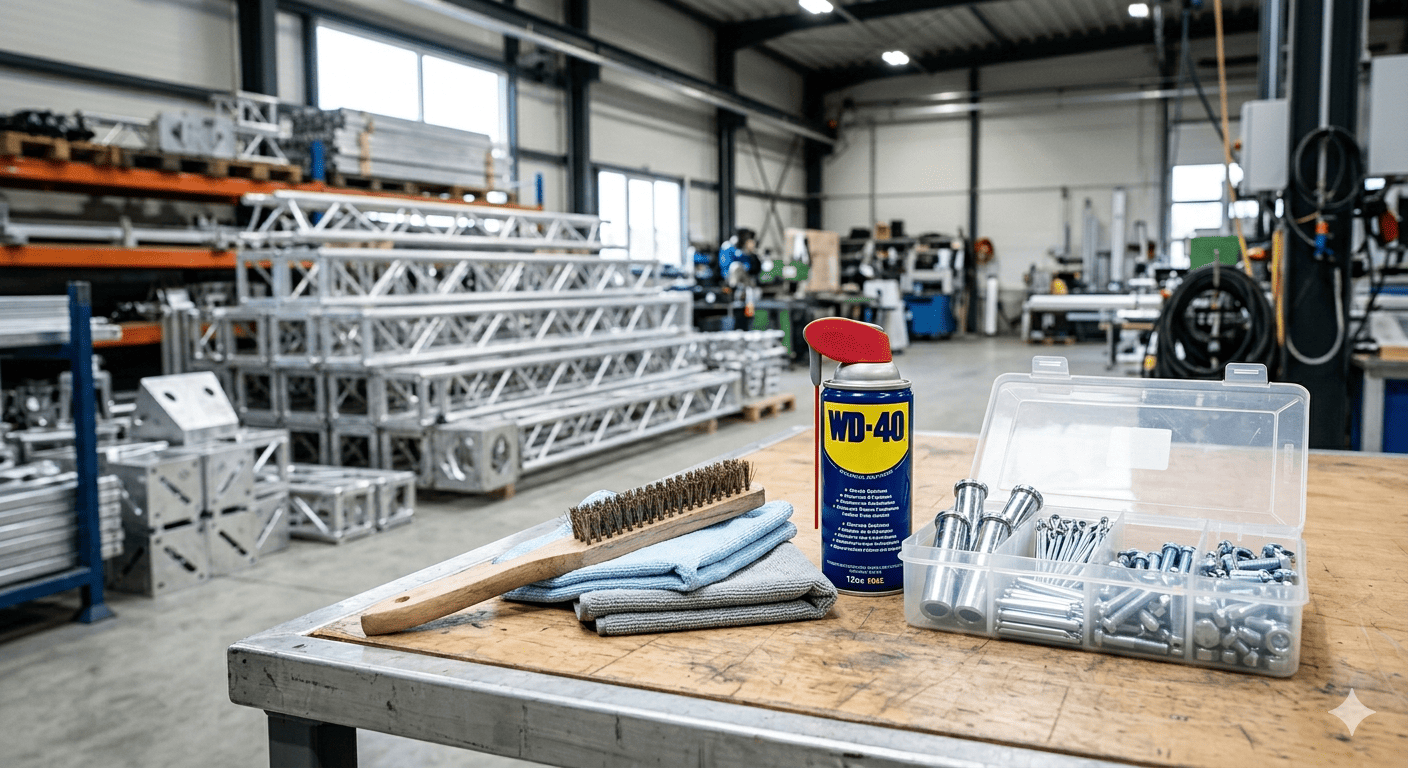
A truss is a system, not a single object. You can't treat the main tubes the same way you treat the small steel parts that do all the hard work of connecting everything. From the questions I get from rental company owners, I've learned that a simple, part-by-part maintenance plan saves them a lot of time and money. It prevents small, cheap-to-fix problems from turning into big, expensive ones. Here’s a breakdown of how we advise our clients to handle maintenance.
Caring for Aluminum Main Tubes
The large aluminum tubes are the most durable part of your truss. The main goal here is to keep them clean and prevent cosmetic damage. After an event, especially an outdoor one, wipe them down with a clean, dry cloth to remove dirt, fingerprints, and moisture. If they are very dirty, you can use a mild soap and water solution, but be sure to rinse and dry them completely. Avoid harsh, acidic, or alkaline cleaners, as they can damage the aluminum's surface finish.6 Check for any deep gouges or scratches that might trap dirt and moisture.
Maintaining Steel Connectors
These are your bolts, pins, couplers, and spigots. They are the most vulnerable parts of the system when it comes to rust.
- Inspect Regularly: Before every setup, give your hardware a quick visual check. Look for any signs of red rust, especially on the threads of bolts.
- Clean Promptly: If you see light surface rust, you can often remove it with a wire brush. For stubborn spots, a specialized rust remover can work, but make sure it's safe for steel.
- Lubricate Sparingly: In very humid climates, a very light coating of a water-displacing lubricant (like WD-40) on the threads of bolts before storage can help. Don't overdo it, as it can attract dirt.
- Replace Immediately: If a bolt or pin is heavily pitted with rust, bent, or has damaged threads, do not try to save it. Steel hardware is cheap. Your truss, your lights, and the safety of people are not. Replace it.
| Component | Maintenance Action | Frequency |
|---|---|---|
| Aluminum Tubes | Wipe clean and dry | After every use |
| Steel Bolts/Pins | Inspect for rust, clean | Before every use |
| Steel Couplers | Check for rust and damage | Before every use |
| Heavily Rusted Hardware | Replace | Immediately upon discovery |
Does the environment affect how you maintain your trusses?
You store your trusses in a shed, and sometimes use them for beachside events. Now you're seeing they're aging much faster than you expected, with connections getting sticky.
Yes, the environment is a huge factor. Trusses used in rainy, humid, or coastal salt-air environments require much more diligent maintenance. They must be thoroughly cleaned and dried after every single use to prevent rapid corrosion of steel parts and staining of the aluminum.

I've had clients from Florida and clients from Arizona. They use the exact same truss products, but their maintenance routines have to be completely different. The single biggest factor that accelerates the "aging" of a truss system is not use, but the environment it's used and stored in. Telling a customer they just need to "keep it clean" isn't enough; we have to talk about their specific situation. Ignoring the environment is the fastest way to turn a high-quality truss into a problematic piece of gear.
Outdoor Events and Rain
This is the most common scenario. The main danger isn't the rain itself, but the water that gets trapped inside the truss tubes and around the connection points after the event. When you transport and store the truss while it's still wet, you're creating a perfect environment for steel bolts to rust and for mold or mildew to form.
Action: After a rainy gig, you must take the time to wipe down every component. If possible, use a leaf blower or compressed air to blow water out of the tubes and connection points. Ensure everything is bone-dry before it goes into storage.
Coastal and High-Salt Environments
Salt is the ultimate enemy of metal. Salt spray from the ocean creates a highly corrosive film on everything.7 It will aggressively attack the steel hardware and can even cause pitting on the aluminum over time8. It also accelerates galvanic corrosion between the steel and aluminum parts.9
Action: If you work near the coast, you have to be extra careful. After the event, it's a good idea to rinse the entire truss system, especially the connectors, with fresh water to wash off the salt deposits. Then, you must dry it completely. This isn't optional; it's essential for survival in a coastal market.
Storage Conditions
Where you store your truss is just as important as how you use it. A damp, unventilated container or basement is a rust factory.10
Action: Store your trusses in a dry, well-ventilated space. Keep them off of a concrete floor, which can hold moisture. Using proper storage racks is the best solution. This allows air to circulate around every piece, keeping them dry.
What are the real risks of ignoring rust and oxidation?
You see a bit of rust on a few bolts and some white dust on the truss, but figure it's just cosmetic. The truss still holds weight, so what's the big deal?
The real risks are operational, not just cosmetic. Rusted bolts and stuck pins slow down your crew, wasting time and money. Severely rusted connectors can be a safety hazard, and confusing normal oxidation for a structural flaw can lead you to discard perfectly good trusses.
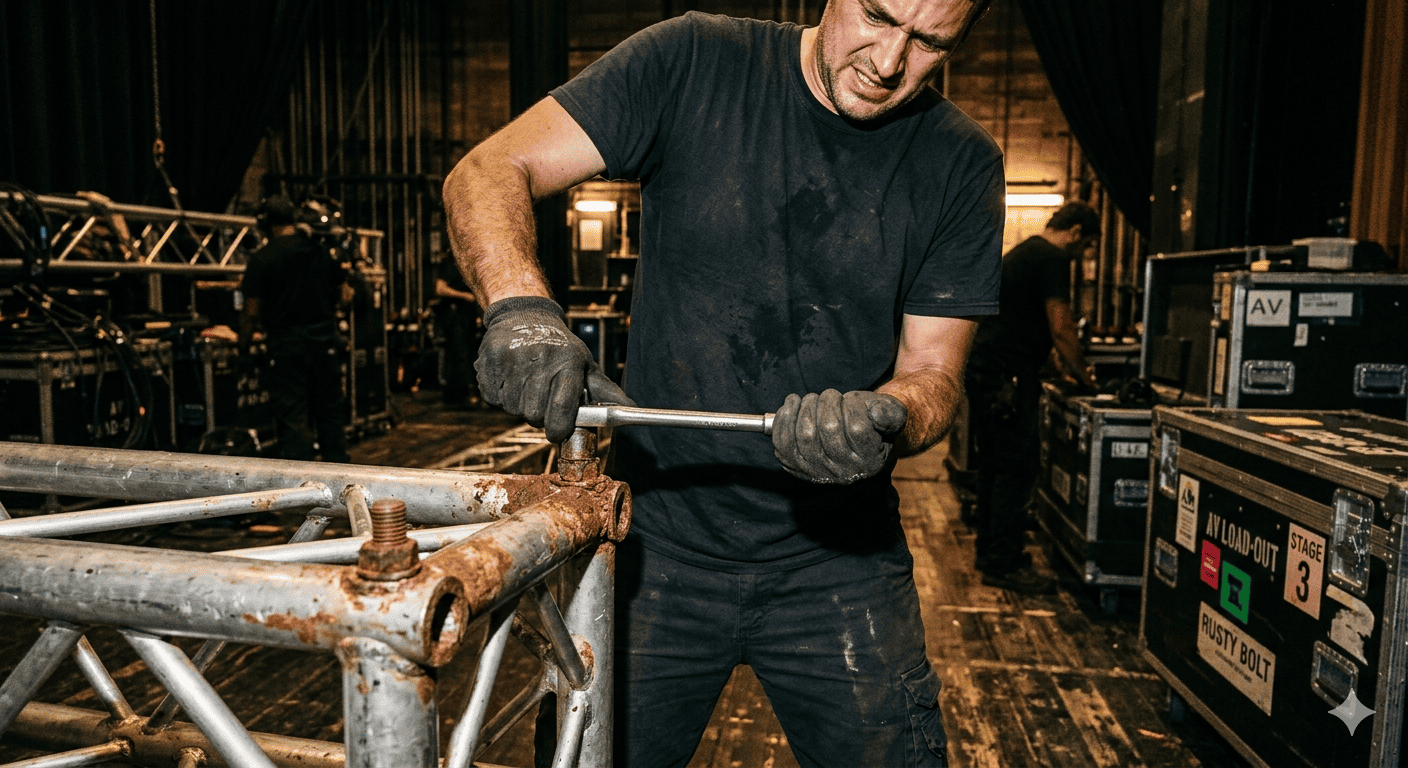
From a business owner's perspective, this is the most important question. A client once told me, "I don't care if it looks perfect, I care if it works and is safe." That's the right attitude. The problem is that ignoring what looks like a small cosmetic issue can directly impact whether the truss "works" efficiently and remains safe. The risks are very real for any company that depends on fast, reliable setups.
Operational Inefficiency
This is the risk that hits your wallet first. When the threads on bolts are rusted, or when pins are corroded and stuck inside the couplers, assembly and disassembly grind to a halt. Your crew wastes precious minutes, sometimes even hours, fighting with stubborn connections. On a tight schedule, this can lead to delays, overtime pay, and a frustrated team. Smooth, clean hardware allows for fast and easy work. Rusted hardware does the opposite.
Safety Concerns
While the aluminum tubes themselves are very unlikely to fail from surface oxidation, the steel connectors are a different story. A bolt that has lost a significant amount of its mass to rust is weaker than a new one.11 More critically, a rusted bolt might not be able to be tightened correctly, leading to a loose connection. A pin that is seized in place might be impossible to inspect properly or fully insert, creating a hidden failure point. These small hardware pieces are what transfer all the load, so their integrity is not negotiable.
Financial Costs
Neglecting maintenance leads to higher costs down the road. Replacing a few rusty bolts every year costs a few dollars. Replacing an entire section of truss because a seized bolt damaged the main tube costs hundreds or thousands. Furthermore, showing up to a corporate event with equipment that looks dirty and has rusty stains gives a very unprofessional impression, which can cost you future business.
| Symptom | Cosmetic Issue | Real Operational Risk |
|---|---|---|
| White powder on aluminum | Yes, looks a bit dull | Minimal. Can be confused for a structural problem. |
| Light surface rust on bolts | Yes, looks unprofessional | Can make bolts harder to turn, slowing down work. |
| Stuck pins or couplers | Not visible when assembled | Major slowdown during setup/teardown. Potential for injury. |
| Deeply pitted, flaky rust | Yes, looks very bad | Significant loss of strength in the connector. A major safety risk. |
Conclusion
Ultimately, caring for your trusses isn't about achieving a rust-free fantasy. It's about smart, targeted maintenance that keeps your gear safe, efficient, and professional-looking for years to come.
A materials science or university source can verify that aluminum naturally forms a protective oxide film that inhibits further corrosion. ↩
A neutral reference can support the terminology that rust is iron oxide associated with iron and steel. ↩
A chemistry or materials source can confirm the surface reaction that creates aluminum oxide in air. ↩
A corrosion reference can explain that steel rusting requires moisture and oxygen, supporting the maintenance warning. ↩
An engineering or corrosion source can verify that dissimilar metals electrically connected through an electrolyte can corrode galvanically. ↩
A materials or conservation source can support that strong acids and alkalis can attack aluminum or its protective oxide surface. ↩
A government, university, or marine-environment source can confirm that chloride-rich salt spray increases metal corrosion rates. ↩
A corrosion source can explain how chlorides can break down aluminum’s passive film and cause localized pitting. ↩
A technical corrosion source can show that saltwater is a conductive electrolyte that increases galvanic corrosion between dissimilar metals. ↩
A building science or corrosion source can support that high humidity and poor ventilation increase corrosion risk during storage. ↩
An engineering or structural safety source can confirm that corrosion reduces cross-sectional area and load capacity in steel fasteners. ↩