Skip to content
You’ve bought a great truss system, but the weather is turning. How can you be sure it's safe? The answer isn't a simple number; it's about understanding real-world risks.
True wind safety for your truss is not a single "safe wind speed" from a manual. It's a dynamic risk assessment based on your specific setup: its height, any attached banners or screens, and the anchoring method you use. The responsibility for these variables is yours.
I've been in the truss manufacturing business for years, and the most common question we get is, "What wind speed can this truss withstand?" I understand why clients like you ask this. You're looking for a simple guarantee, a number that lets you sleep at night. But honestly, that question is the start of a dangerous path built on assumptions. The truss itself is incredibly strong.1 The real danger comes from how you use it in an open environment.
The truth is, a truss structure's safety in wind has less to do with the aluminum beams and more to do with things you control. Let’s stop looking for a magic number and start asking the right questions. This will help you manage risk effectively, protect your audience, and safeguard your business. Let's break down what really matters.
Why Is 'What Wind Speed Can It Withstand?' the Wrong Question?
You ask your supplier for a wind speed rating, hoping for a clear, simple answer. But a single number is dangerously misleading and can't possibly account for your specific event.
This is the wrong question because the truss itself is rarely the point of failure. The danger comes from the forces applied to it by things you add, like banners, screens, and lighting, which turn your structure into a massive sail2.
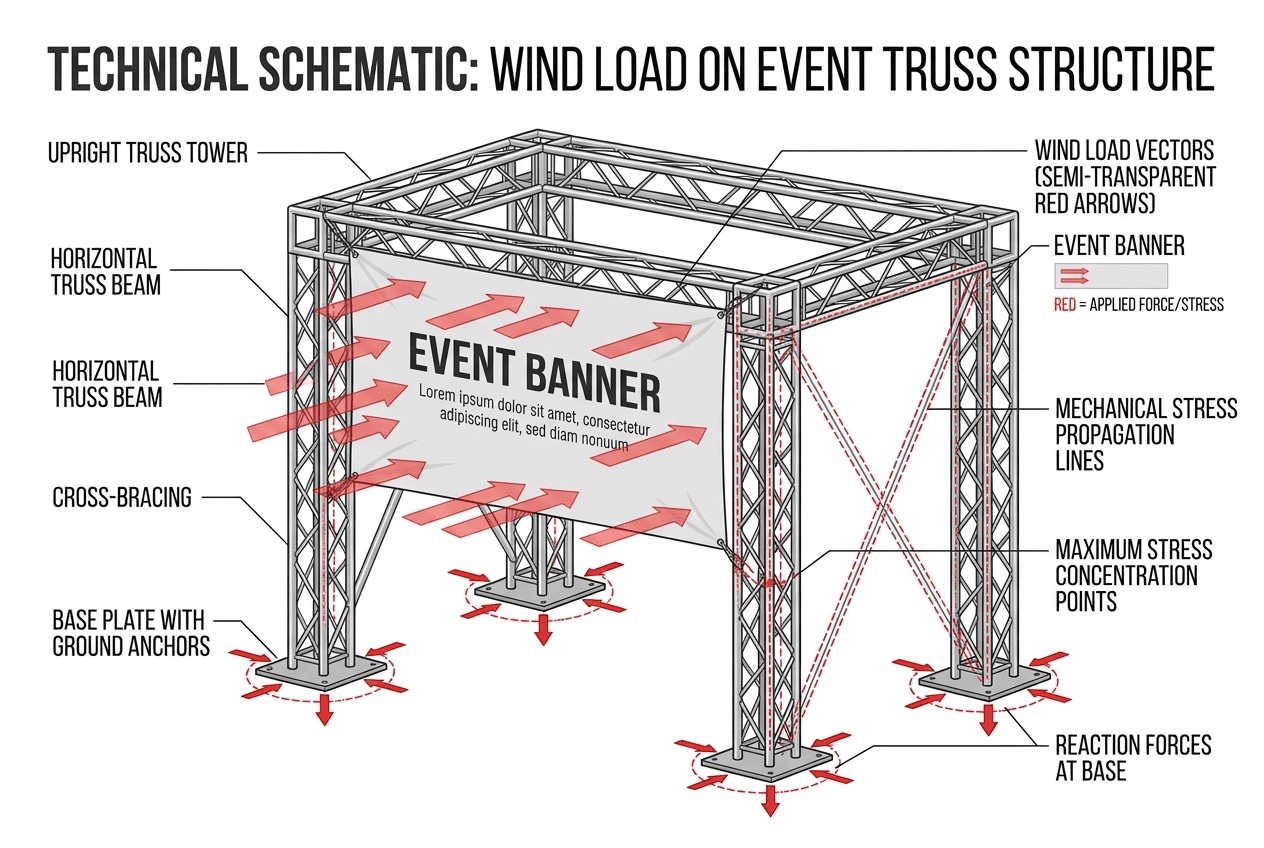
From our experience at the factory, the raw strength of a certified truss section is immense. It's designed to hold heavy loads. The real problem is wind load, which is a different kind of force. Think of it this way: a bare truss structure allows wind to pass through it. But the moment you attach a solid surface—a vinyl banner, an LED video wall, or even dense lighting rigs—the entire dynamic changes. You've created a sail. The force of the wind is now caught by this surface and transferred directly to the structure. The higher you build, the more leverage the wind has, dramatically increasing the force trying to topple your entire setup.3 This is why a simple "wind rating" for a piece of truss in isolation is almost meaningless in the real world. The critical factors are controlled by you, the user, on the day of the event.
Key Variables You Control
| Variable | Low-Risk Example | High-Risk Example | Why It Matters |
|---|---|---|---|
| Attached Surfaces | Bare truss frame | Truss with a 20sqm LED wall | Solid surfaces catch the wind like a sail, multiplying the force on the structure. |
| Height | 3-meter goal post | 10-meter tower | Taller structures give the wind more leverage, increasing the toppling moment at the base. |
| Shape | A flat, low-profile grid | A tall, narrow archway | Tall, narrow structures have a smaller, less stable base relative to their height. |
| Location | Sheltered urban courtyard | Open field or coastline4 | Natural or man-made structures can block wind, while open areas allow it to accelerate. |
How Does Your Event's Scenario Change the Wind Risk?
You use the same high-quality truss for all your jobs, so the safety is the same, right? Unfortunately, you might be applying indoor safety assumptions to a high-risk outdoor situation.
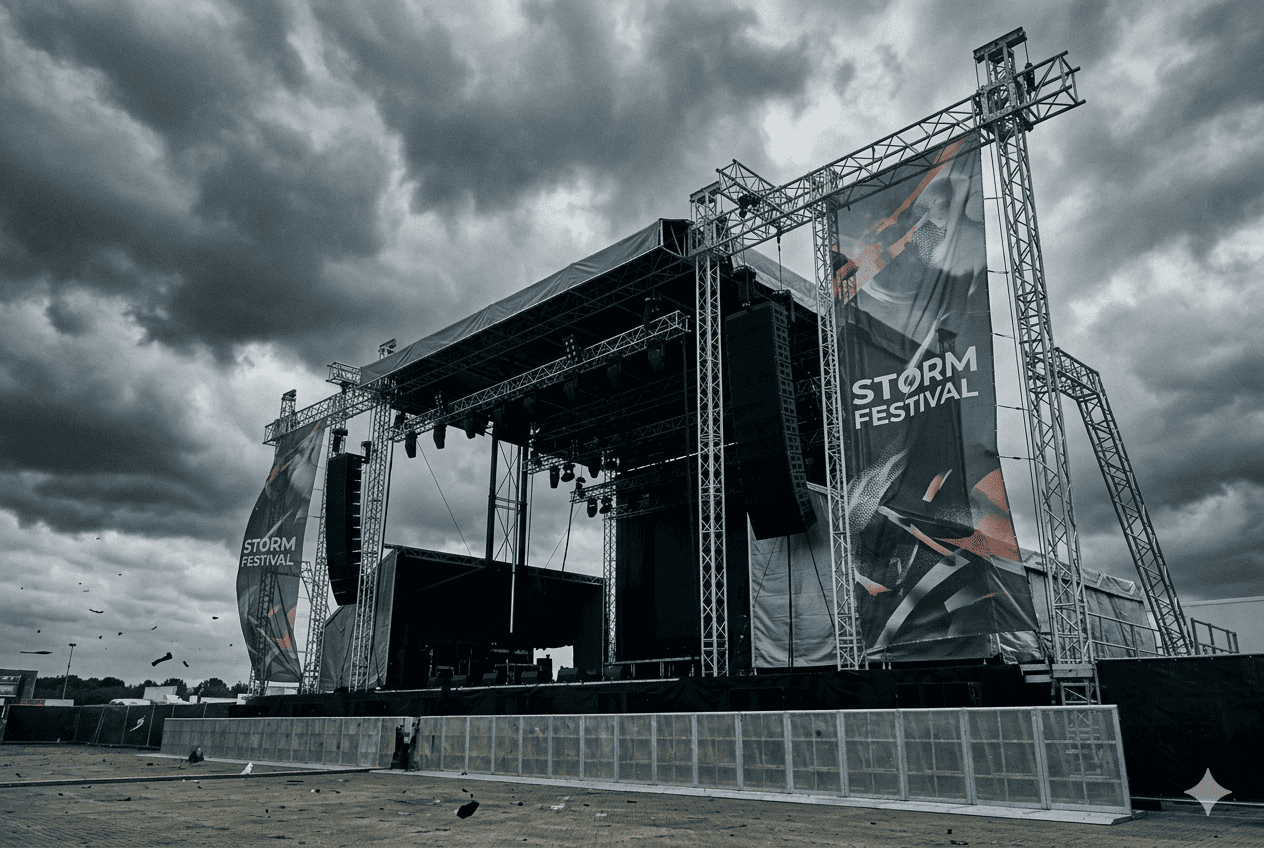
Your event scenario is the single biggest factor in determining wind risk. An indoor trade show booth has almost zero wind risk, while an outdoor festival stage is an entirely different engineering challenge5 requiring extensive precautions and planning.

When we work with clients, the first thing we discuss is the intended use. The exact same truss system can be perfectly safe in one context and a severe liability in another. For an indoor expo, your primary concern is the load-bearing capacity for hanging lights and signs. Wind isn't a factor. Take that same structure outside for a weekend festival, add a branded backdrop, and place it in an open field, and the risk profile skyrockets. Now, you must consider not just the weight it can hold, but the immense horizontal force the wind will exert on it. Production managers for large tours know this well. They have different protocols for indoor arenas, outdoor stadiums, and temporary festival fields6 because each environment presents unique challenges. The key takeaway is to stop thinking about the truss as a static object and start assessing it as part of a dynamic environmental system.
Comparing Common Event Scenarios
| Event Scenario | Typical Wind Risk | Key Safety Considerations |
|---|---|---|
| Indoor Expo Booth | Negligible | Load capacity for hanging equipment, structural stability. |
| Outdoor Banner Stand | Moderate | Sufficient base weight (ballast), risk of tipping over, securing banners properly. |
| Small Outdoor Stage (e.g., community fair) | High | Height of the roof, size of backdrops/banners, proper ballasting, monitoring weather. |
| Large Festival Stage (e.g., concert) | Extreme | Use of large video/sound wings, guy wires, professional engineering sign-off, detailed wind action plan. |
Is Your TUV Certificate Actually Keeping You Safe?
You insisted on a supplier with TUV-certified truss because you value safety. You have the paperwork, so you assume you're covered. But what does that certificate really guarantee?
A TUV or engineering certificate is a vital starting point, proving the truss meets manufacturing and material standards under specific test conditions7. It does NOT automatically guarantee safety for your unique, real-world application with its specific height, loads, and banners.

We are proud of the certifications our products carry. They are proof of our commitment to quality materials and welding standards. However, as a manufacturer, I feel it's my responsibility to tell you what these certificates don't cover. A certificate is based on a set of assumptions—a specific span, a certain type of loading, and, most importantly, no unpredictable side forces from wind. When a lab tests a truss, they are not setting it up in a field with a 50-foot banner in a storm.8 They are verifying that the aluminum and the welds will perform as expected under a calculated, predictable load.
This is why you need to ask smarter questions. Don't just ask, "Is it certified?" Ask, "What were the assumptions used for this load table?" or "How do these calculations change if I add a 20-square-meter LED screen to the back?" A good supplier won't be annoyed; they'll respect that you're a professional who understands risk. They should be able to provide guidance or direct you to a structural engineer to analyze your specific scenario. The certificate is step one; applying its principles to your event is step two.
What Makes Up a Complete Wind Safety System?
You’ve bought the best truss, so you believe you’ve done everything you can for safety. But when a storm rolls in, you realize the truss itself is only one piece of the puzzle.
A complete wind safety system is a holistic approach.9 It includes the truss, yes, but more importantly, it involves proper ballasting, secure anchoring, stabilizing guy wires, and a clear, pre-defined action plan for when wind speeds rise.

From our experience delivering systems for major outdoor festivals, the most common oversight is focusing on the structure and forgetting the foundation. The truss won't topple because the aluminum bends; it will topple because the forces acting upon it overwhelm its base. A complete system is what separates amateurs from professionals. It starts with ballasting. Are you using enough weight?10 Are the ballast blocks placed correctly to provide the most leverage against tipping? If you're on soft ground, anchoring with massive ground stakes might be better. For tall structures, guy wires are non-negotiable.11 They provide critical lateral stability that the base alone cannot.
Finally, and most importantly, is your action plan. This means having a wind meter (anemometer) on-site, knowing your "action" wind speed (e.g., at 25 mph, remove all banners), and your "stop" wind speed12 (e.g., at 35 mph, lower the structure and clear the area). Who is responsible for monitoring? Who makes the call? Having these answers before the wind picks up is the very definition of professional event management.
Conclusion
Stop asking for a single wind speed number. Instead, adopt a professional risk assessment for your specific event. This focus on the complete system ensures real safety and peace of mind.
"6082 aluminium alloy - Wikipedia", https://en.wikipedia.org/wiki/6082_aluminium_alloy. A materials engineering resource can provide data on the mechanical properties of aluminum alloys, such as 6082-T6, commonly used in truss manufacturing, demonstrating their high strength-to-weight ratio which makes them suitable for load-bearing structures. Evidence role: general_support; source type: encyclopedia. Supports: The claim that truss aluminum is very strong.. ↩
"Aerodynamic Forces | Glenn Research Center - NASA", https://www1.grc.nasa.gov/beginners-guide-to-aeronautics/aerodynamic-forces/. A paper or guide on structural engineering can explain the 'sail effect,' detailing how non-porous attachments like banners dramatically increase the wind load on a structure by presenting a larger surface area to the wind, thereby increasing the drag coefficient. Evidence role: mechanism; source type: paper. Supports: The claim that adding surfaces to a truss creates a 'sail effect'.. ↩
"[PDF] STRUCTURAL STABILITY - Half Course - Purdue Engineering", https://engineering.purdue.edu/~ahvarma/CE%20579/CE579_Half_course_summary.pdf. A physics or structural engineering textbook can explain the concept of an overturning moment, which is calculated as force multiplied by the height at which it is applied. This demonstrates why taller structures are more susceptible to toppling from wind forces. Evidence role: mechanism; source type: education. Supports: The claim that height increases the toppling force.. ↩
"[PDF] Impacts of Terrain Slope and Surface Roughness Variations on ...", https://repository.library.noaa.gov/view/noaa/70105/noaa_70105_DS1.pdf. A structural engineering standard, such as ASCE/SEI 7, defines exposure categories based on terrain roughness. Open terrain, like fields or coastlines (Exposure Category C or D), is associated with higher wind speeds and loads compared to sheltered urban areas (Exposure Category B). Evidence role: definition; source type: government. Supports: The claim that location (e.g., open field) is a high-risk factor.. ↩
"[PDF] Temporary Structures Manual, Compiled PDF - Caltrans", https://dot.ca.gov/-/media/dot-media/programs/engineering/documents/structureconstruction/temp-str/sc-temp-str-manual.pdf. Guidelines from professional bodies, such as the Institution of Structural Engineers (IStructE), detail the specific engineering considerations for temporary outdoor structures, including mandatory wind load analysis, ballasting, and wind management plans, which are not required for most indoor applications. Evidence role: expert_consensus; source type: institution. Supports: The claim that outdoor stages present a unique engineering challenge.. ↩
"[PDF] The Event Safety Guide - Montana Department of Commerce", https://commerce.mt.gov/_shared/brand/Tourism-Grants/Docs/The_Event_Safety_Guide.pdf. Publications from event safety organizations like the Event Safety Alliance (ESA) or the Production Services Association (PSA) often describe best practices in touring production, which include developing tiered safety protocols that adapt to the unique risks of different venue types, such as indoor arenas versus outdoor festival fields. Evidence role: case_reference; source type: institution. Supports: The claim that professionals use different protocols for different venues.. ↩
"TÜV - Wikipedia", https://en.wikipedia.org/wiki/T%C3%9CV. The website of a certification body like TÜV SÜD, or a standards organization, can clarify that product certification verifies compliance with specific manufacturing and material standards (e.g., Eurocodes) based on calculations and tests performed under controlled, specified conditions. Evidence role: definition; source type: institution. Supports: The claim about what a TUV certificate proves.. Scope note: The source would also implicitly support the article's broader point by showing that certification does not cover unique, on-site applications. ↩
"24 CFR 3280.402 -- Test procedures for roof trusses. - eCFR", https://www.ecfr.gov/current/title-24/subtitle-B/chapter-XX/part-3280/subpart-E/section-3280.402. A document outlining standards for structural component testing (e.g., from ASTM International or CEN) would describe the controlled laboratory conditions, which typically involve applying predictable, static loads to verify capacity, illustrating the difference between certification testing and the dynamic, unpredictable forces of wind in a real-world setting. Evidence role: mechanism; source type: research. Supports: The claim that lab tests do not replicate real-world storm conditions.. ↩
"Event Safety Management: A Guide to Prioritizing Protection in ...", https://extendedstudies.ucsd.edu/news-events/extended-studies-blog/event-safety-management-a-guide-to-prioritizing-protection-in-every-event-plan. Safety guidelines from government bodies, such as the UK's Health and Safety Executive (HSE) guidance on temporary demountable structures, emphasize a 'systems approach' to safety, requiring consideration of the entire structure, its foundation, anchoring, and a procedural wind management plan. Evidence role: expert_consensus; source type: government. Supports: The claim that wind safety requires a holistic system.. ↩
"[PDF] Determination of Safe Ballasts for Anchoring Event Tents by Finite ...", https://open.clemson.edu/cgi/viewcontent.cgi?article=3812&context=all_theses. An industry standard, such as ANSI E1.21 - 2013 (Entertainment Technology—Temporary Ground-Supported Overhead Truss Systems), provides detailed methodologies for calculating the required amount of ballast to counteract overturning forces from wind, confirming that determining 'enough weight' is a formal engineering task. Evidence role: general_support; source type: institution. Supports: The claim that using 'enough' ballast weight is a critical consideration.. ↩
"Guy-wire - Wikipedia", https://en.wikipedia.org/wiki/Guy-wire. A structural engineering guide on temporary structures can explain that guy wires provide critical lateral stability by creating a wider effective base and transferring horizontal loads (like wind) directly to ground anchors, thereby preventing buckling or overturning in tall, slender structures. Evidence role: mechanism; source type: education. Supports: The claim that guy wires are non-negotiable for tall structures.. ↩
"[PDF] Event Ready Guide - National Weather Service", https://www.weather.gov/media/crh/eventready/Event_Ready_Guide.pdf. A guide on wind management from an organization like the Event Safety Alliance (ESA) defines the concept of tiered action levels, establishing specific wind speeds that trigger pre-planned responses, such as an 'action' speed to remove banners and a higher 'stop' speed to evacuate the area and lower the structure. Evidence role: definition; source type: institution. Supports: The claim that wind plans use 'action' and 'stop' speeds.. ↩