Skip to content
Lifting a large truss structure feels risky, and a failure during the lift is catastrophic. The secret isn't a magical hinge, but understanding how to match the right system to your plan.
A risk-free erection with hinge sections depends on matching the hinge's load capacity to the dynamic forces of your specific lift1. You must consider the structure's size, weight, and the entire support system, from the base plate to the lifting method. It's about the whole system, not just one part.
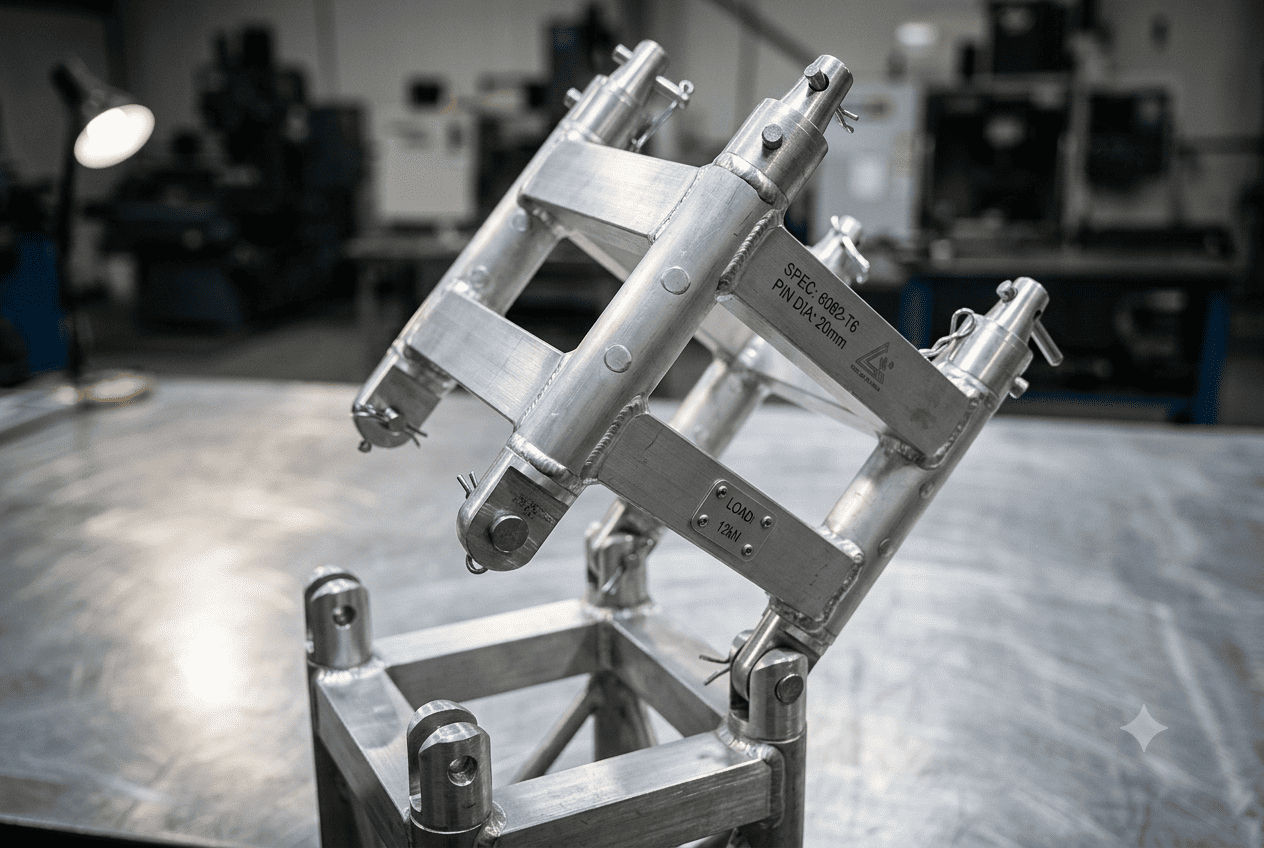
Many people focus only on the hinge itself. They believe if the hinge is big and heavy, it must be safe. But from our experience at KRD Truss, helping customers plan their setups, we've seen that this thinking is incomplete. The real key to safety lies in looking at the whole picture, from the ground up.2 This approach prevents costly mistakes and ensures a smooth, secure lift every time. Let's break down what that means for your next project.
Is Your Hinge Section Strong Enough for the Actual Lift?
You've picked a hinge section that looks heavy-duty, but you're still unsure if it can handle your large structure. The key is to stop asking if it's "strong" and start asking about its tested limits.
A hinge's strength isn't just its final, static rating. For a safe lift, you must know its capacity to handle dynamic loads, which are highest as the structure pivots from horizontal to vertical3. Always verify the hinge system was designed and tested for your structure's specific size and lifting procedure.
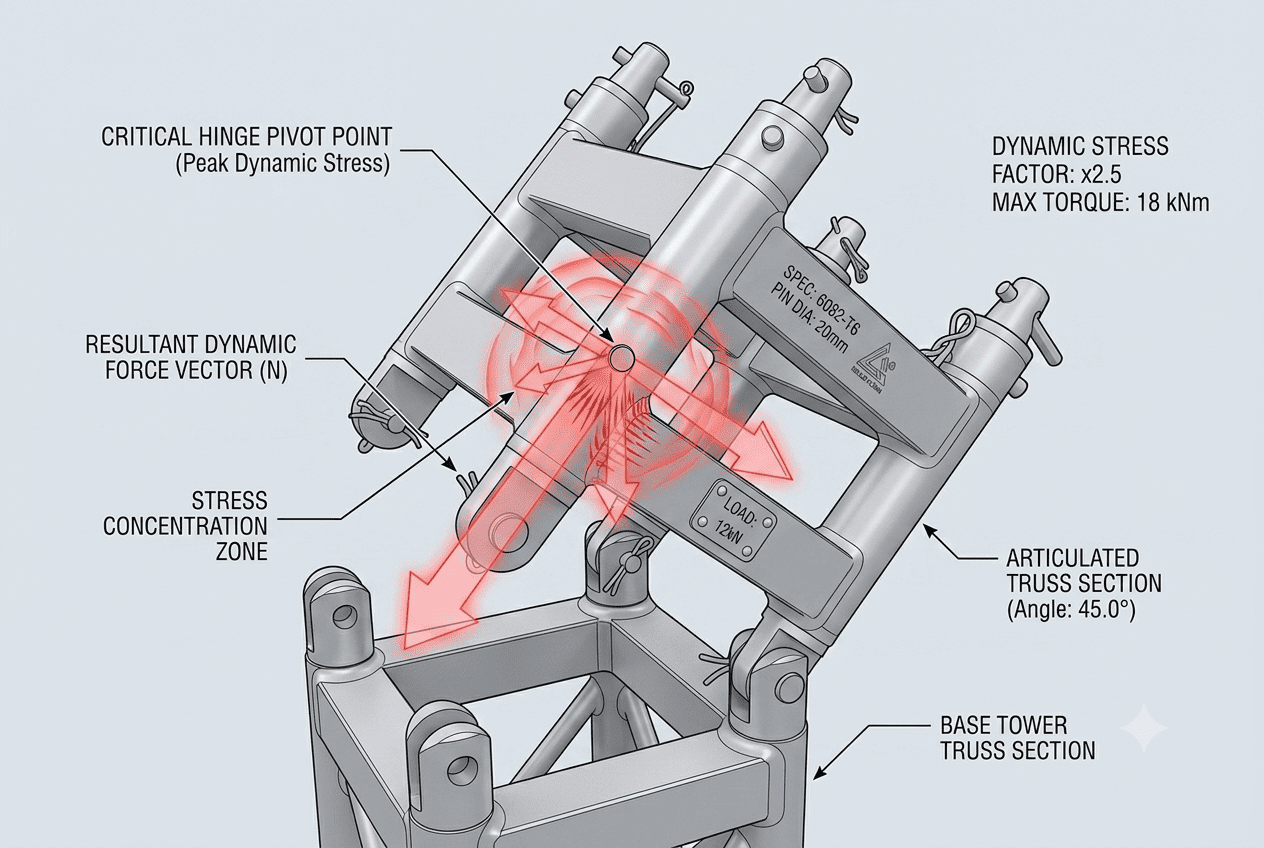
A common question we get is about the strength of our hinge components. But "strength" is a tricky word. It’s more useful to talk about two types of loads: static and dynamic. A static load is the weight of the truss structure when it's standing still and fully assembled. A dynamic load is the force applied to the system while it's moving. Think about lifting a heavy box from the floor. Just holding the box in your arms is the static load. The hardest part is the actual lift, where you feel the strain increase—that's the dynamic load. In a truss lift, this dynamic force is highest when the structure is at about a 45-degree angle4. This is the moment of greatest risk, where a mismatch between the hinge's capacity and the force can cause a failure. You need to know the hinge can handle this peak moment.
| Bad Question | Good Question |
|---|---|
| Is this hinge strong? | What is the maximum dynamic load this hinge system can handle? |
| Will this work for my goal post? | For what size and weight of structure was this hinge tested? |
| Is the hinge pin solid? | What are the tested failure points of the complete hinge assembly? |
Does Your Erection Plan Account for Real-World Physics?
You have a strong hinge and a solid truss, so you think you're ready to lift. But unexpected forces can cause the base to slide or the truss to buckle5, even if the hinge holds.
A safe erection plan considers the entire system's physics. This includes securing the base against sliding, bracing the truss near the hinge to prevent buckling, and using a lifting method that provides a smooth, controlled pull. It is a planned process, not a simple pivot.

What we've seen from project feedback is that most problems don't happen because a quality hinge breaks. They happen because of the things around the hinge. The physics of the lift create forces that go in multiple directions. The hinge acts as a pivot, but there is also a strong horizontal force trying to push the base towers apart6 or pull them together, depending on your setup. If the base isn't secured on level, solid ground, it can slip or tip over. A customer might have powerful chain hoists, but they forget to anchor the base against this sliding force. It’s like trying to do a push-up on a slippery, wet floor—your hands will slide out. We always remind our clients to think about the entire chain of events. A safe lift is a well-planned procedure that accounts for every force involved.
Key Steps in a Safe Erection Plan
| Step | Key Action | Why It Matters |
|---|---|---|
| Ground Prep | Ensure ground is level and firm. Use large steel base plates. | An uneven or soft surface can cause the entire structure to shift or sink under the immense load7 during the lift, leading to instability. |
| Base Securing | Anchor the hinge base against sliding and tipping forces. | The lift creates a strong horizontal push/pull at the base. Without anchors (like stakes or heavy ballasts), the base can easily slide, causing a collapse.8 |
| Lift Point | Use a high and properly positioned lifting point. | A low lifting angle on your chain hoist or crane increases the horizontal stress on the base.9 A higher angle makes the lift more vertical and stable. |
| Bracing | Add bracing to truss sections near the hinge if needed. | The truss chords near the hinge are under extreme compression during the lift.10 Extra bracing can prevent them from bending or buckling unexpectedly.11 |
Are You Asking Your Supplier the Right Safety Questions?
You need to buy hinge sections, but you feel lost in the technical details. Asking a general question like "Is it safe?" gives you no real information to make a good decision for your team.
Do not just ask if a hinge is "safe." Ask for specific documentation. What is the tested failure point?12 For what size and weight of structure was this hinge system designed? What erection procedure do you recommend? A good supplier will have clear answers for you.

"[PDF] ANSI E1.21 - 2020 Entertainment Technology - NU Wirtz Center", https://nutheatrestock.org/training/wp-content/uploads/sites/5/2021/08/Outdoor-Temp-Structures-ANSI-E1.21-2020.pdf. Engineering standards for rigging and lifting, such as those from the Professional Lighting and Sound Association (PLASA), mandate that all components must be rated for the dynamic loads generated during movement, which can significantly exceed the static weight of the structure. Evidence role: definition; source type: institution. Supports: The source should define static vs. dynamic loads and state that lifting equipment must be rated for the dynamic loads encountered during operation, not just the static weight of the object.. ↩
"Construction Incidents Investigation Engineering Reports - OSHA", http://www.osha.gov/construction/engineering/search. Safety bodies like the Occupational Safety and Health Administration (OSHA) emphasize a systems approach to construction and erection safety, where risk is managed by considering the entire operational environment, including ground support, equipment interaction, and procedural integrity. Evidence role: general_support; source type: government. Supports: The source should advocate for a comprehensive safety plan that considers all interacting elements, from ground conditions to equipment and procedure, rather than relying on the strength of a single part.. ↩
"[PDF] Rotation and Torque (Equilibrium of Rigid Bodies)", https://physics.howard.edu/sites/physics.howard.edu/files/2020-10/7-Rotation%20and%20Torque1.pdf. According to principles of engineering mechanics, the act of lifting or pivoting a structure generates dynamic loads due to acceleration and inertia, which are superimposed on the static weight and are typically greatest while the object is in motion. Evidence role: mechanism; source type: education. Supports: The source should explain that moving a mass, especially through a rotational path, introduces inertial and acceleration forces that add to the static gravitational load, creating a peak 'dynamic load' during the motion.. ↩
"[PDF] Moment-Reducing Hinge Details for the Bases of Bridge Columns", https://www.wsdot.wa.gov/research/reports/fullreports/220.1.pdf. Mechanical analysis of pivoting a uniform beam from a horizontal to a vertical position shows that the bending moment and horizontal reaction force at the hinge typically reach their maximum at an intermediate angle, often near 45 degrees, depending on the geometry of the lifting rig. Evidence role: mechanism; source type: paper. Supports: The source should provide a force analysis (e.g., using free-body diagrams) of a hinged lift, showing how the reaction forces at the hinge vary with the angle of the lift.. Scope note: The precise angle of maximum force depends on factors like the position of the lifting point and the distribution of mass in the structure. ↩
"Jet Set nightclub roof collapse - Wikipedia", https://en.wikipedia.org/wiki/Jet_Set_nightclub_roof_collapse. Investigations into temporary structure failures have shown that collapses often occur not from the failure of a primary rated component, but from secondary effects like base instability or the buckling of members under unpredicted compressive loads during erection. Evidence role: case_reference; source type: research. Supports: The source should document instances or analyses of structural failures during erection where the cause was not a primary component failure but rather an unmanaged force leading to instability, such as base slippage or member buckling.. ↩
"Axial Force Diagrams and Torque Diagrams - Mechanics Map", https://mechanicsmap.psu.edu/websites/6_internal_forces/6-3_axial_torque_diagrams/axial_torque_diagrams.html. A free-body diagram of a hinged structure during a lift demonstrates that the angled lifting force and gravity resolve into both vertical and horizontal reaction forces at the base pivots. This horizontal thrust must be counteracted to prevent the bases from sliding apart. Evidence role: mechanism; source type: education. Supports: The source should explain, using principles of statics, how lifting a hinged structure creates a horizontal reaction force at the base pivot points.. ↩
"Foundation requirements for scaffolds; competent person ... - OSHA", http://www.osha.gov/laws-regs/standardinterpretations/2000-08-01-1. Safety guidelines for temporary structures and scaffolding require that they be erected on firm, level ground capable of supporting the maximum intended load without shifting or sinking, often necessitating the use of sole plates or matting to distribute the load. Evidence role: general_support; source type: government. Supports: The source should specify the need for firm, level foundations for temporary structures and explain the risks associated with inadequate ground support, including differential settlement and instability.. ↩
"[PDF] Temporary Structures Guidelines", https://adminrecords.ucsd.edu/ppm/docs/420-9-DG.pdf. Structural engineering guides for temporary events provide methodologies for calculating the horizontal thrust at the base of a hinged lift and specify that sufficient ballast or ground anchorage must be used to counteract this force with an appropriate safety margin. Evidence role: mechanism; source type: institution. Supports: The source should provide methods for calculating the horizontal forces during a lift and determining the necessary anchoring or ballast weight required to achieve a sufficient factor of safety against sliding.. ↩
"Vectors - Mechanics Map", https://mechanicsmap.psu.edu/websites/A1_vector_math/A1-1_vectors/vectors.html. Basic principles of physics show that as the angle of a lifting cable or sling relative to the load becomes shallower (more horizontal), the tension in the cable and the horizontal force component it exerts increase dramatically for the same vertical lift. Evidence role: mechanism; source type: education. Supports: The source should explain the trigonometric relationship between the angle of a lifting line and the distribution of force into vertical and horizontal components.. ↩
"[PDF] Method of Sections", https://www.purdue.edu/freeform/statics/wp-content/uploads/sites/13/2018/10/LectureNotes_Period_22-Posted-min.pdf. Finite element analysis and structural models of hinged truss erection show that the section of the truss between the hinge and the lift point acts as a cantilever, placing the lower chords under high compressive stress and the upper chords under tension. Evidence role: mechanism; source type: paper. Supports: The source should analyze the forces in a truss during a hinged lift, identifying the lower chords near the pivot as being in compression due to cantilever action.. ↩
"Euler's critical load - Wikipedia", https://en.wikipedia.org/wiki/Euler%27s_critical_load. Structural engineering principles dictate that the buckling strength of a compression member is inversely related to the square of its effective length. Adding lateral bracing reduces this effective length, significantly increasing the member's capacity to resist buckling forces. Evidence role: mechanism; source type: education. Supports: The source should explain the concept of buckling in long, slender members under compression and how adding lateral bracing reduces the effective length of the member, thereby increasing its resistance to buckling.. ↩
"Factor of safety - Wikipedia", https://en.wikipedia.org/wiki/Factor_of_safety. In structural engineering, the safe working load (SWL) or working load limit (WLL) of a component is determined by destructive testing to find its ultimate breaking strength, which is then divided by a prescribed factor of safety (e.g., 5:1 or higher) to establish a rated capacity. Evidence role: definition; source type: institution. Supports: The source should explain that safety ratings for structural components are derived from testing that determines the ultimate failure point, to which a factor of safety is then applied.. ↩